
The Ten Commandments and the Seventh-day Sabbath
The Law, the Sabbath, and the Heavenly Sanctuary • ~10 min read
The Ten Commandments and the Seventh-day Sabbath
Foundations of Faith: 28 Core Adventist Doctrines for Youth — Lesson 8
Have you ever wondered why some rules seem to last forever while others fade away? Speed limits change, dress codes get updated, and cultural expectations shift from generation to generation. But some things — like the pull of gravity or the rising of the sun — never change, because they are woven into the very fabric of reality. In this lesson, we will discover that God's Ten Commandments belong to that same category of unchanging truth. And at the heart of those commandments, we will find a gift that most of the world has forgotten: the seventh-day Sabbath.
Part One: The Law Written in Stone
Where Did the Ten Commandments Come From?
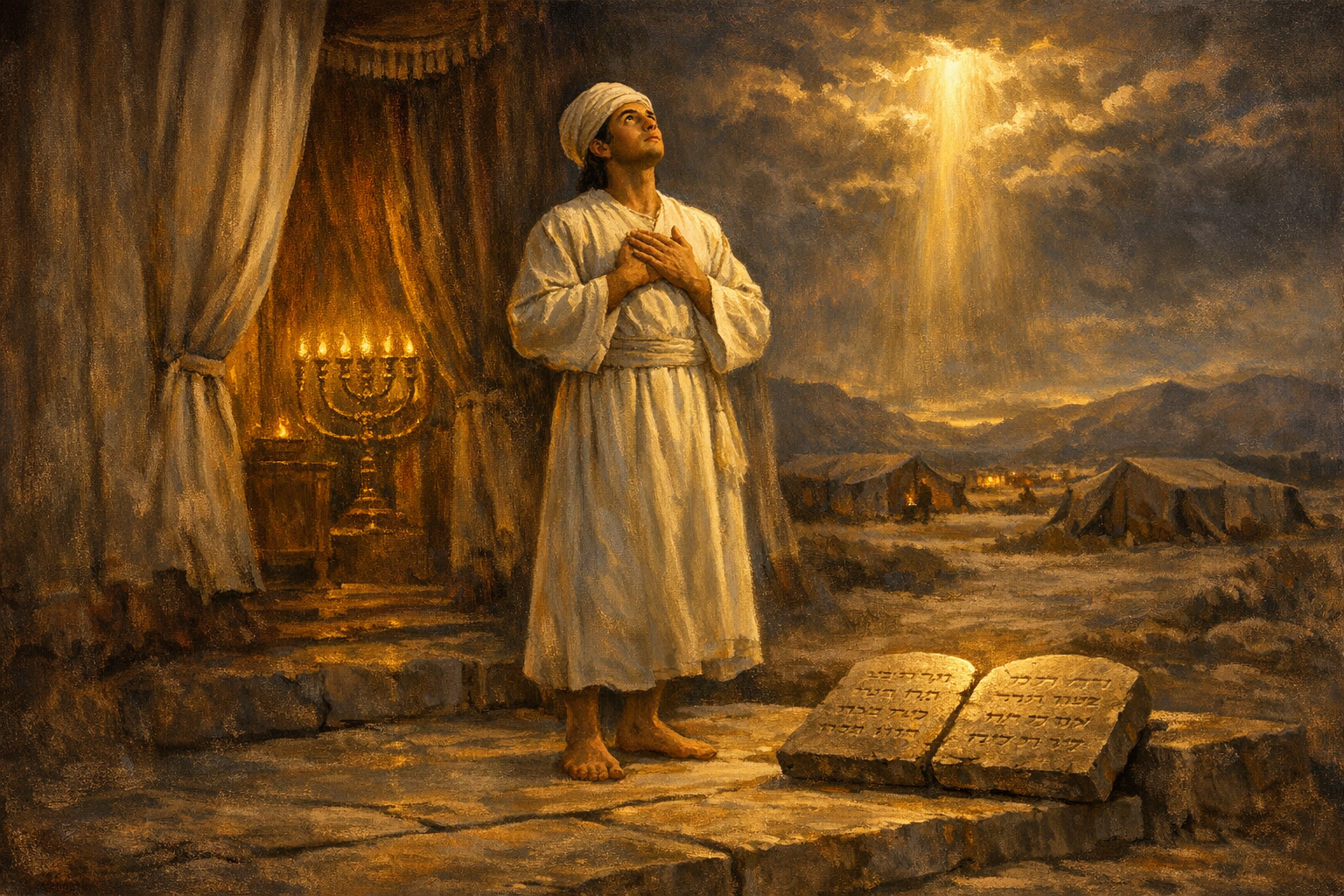
The Ten Commandments were not invented by Moses. They were spoken aloud by God Himself from the fire and smoke of Mount Sinai, and then inscribed by His own finger on two tablets of stone. The dramatic setting was intentional — God wanted Israel (and us) to understand that these words carry a weight unlike any other.
"And he declared unto you his covenant, which he commanded you to perform, even ten commandments; and he wrote them upon two tables of stone." — Deuteronomy 4:13 (KJV)
"And the tables were the work of God, and the writing was the writing of God, graven upon the tables." — Exodus 32:16 (KJV)
Stone is a symbol of permanence. Ceremonial laws — the sacrificial system, the dietary regulations tied to the Levitical priesthood, the feast-day calendars — were written by Moses in a book and placed beside the ark (Deuteronomy 31:26). The Ten Commandments, however, were placed inside the ark of the covenant (Deuteronomy 10:5), under the mercy seat. This distinction matters enormously: the moral law was enshrined at the very center of Israel's worship, hidden beneath the symbol of God's grace.
The Two Tables: Love for God and Love for Others
When Jesus was asked which commandment is the greatest, He did not abolish the Ten Commandments — He summarized them:
"Jesus said unto him, Thou shalt love the Lord thy God with all thy heart, and with all thy soul, and with all thy mind. This is the first and great commandment. And the second is like unto it, Thou shalt love thy neighbour as thyself. On these two commandments hang all the law and the prophets." — Matthew 22:37-40 (KJV)
Commandments one through four describe our love for God. Commandments five through ten describe our love for our neighbor. Jesus was not replacing the Decalogue; He was revealing its inner logic. The law is a transcript of God's character — it shows us what love looks like in action.
Part Two: Did Jesus Abolish the Law?
This is perhaps the most important question young believers face. Some teachers claim that the cross cancelled the Ten Commandments, leaving Christians free from any moral standard. But Jesus Himself addressed this directly:
"Think not that I am come to destroy the law, or the prophets: I am not come to destroy, but to fulfil. For verily I say unto you, Till heaven and earth pass, one jot or one tittle shall in no wise pass from the law, till all be fulfilled." — Matthew 5:17-18 (KJV)
The word "fulfil" here does not mean "bring to an end." It means to fill up to the full measure — to demonstrate the law's deepest meaning. Jesus fulfilled the ceremonial law by becoming the Lamb of God (the sacrificial system pointed to Him). But the moral law — the Ten Commandments — He obeyed perfectly, magnified in the Sermon on the Mount, and wrote on the hearts of believers through the Holy Spirit.
"Do we then make void the law through faith? God forbid: yea, we establish the law." — Romans 3:31 (KJV)
Obedience: Fruit, Not Root
Here is the crucial distinction every young Christian must grasp: we are not saved because we keep the commandments. We keep the commandments because we are saved. Salvation comes entirely through faith in Jesus Christ — His perfect life credited to our account (justification) and His Spirit transforming us from the inside out (sanctification).
"For by grace are ye saved through faith; and that not of yourselves: it is the gift of God: Not of works, lest any man should boast." — Ephesians 2:8-9 (KJV)
But the very next verse continues: "For we are his workmanship, created in Christ Jesus unto good works, which God hath before ordained that we should walk in them" (Ephesians 2:10, KJV). Grace does not make us lawless — it empowers us to live in harmony with God's character. Obedience is the fruit of a transformed heart, not a ladder we climb to earn God's favor.
"If ye love me, keep my commandments." — John 14:15 (KJV)
Part Three: The Fourth Commandment — A Forgotten Gift
The Commandment Itself
Of all ten commandments, the fourth is the longest and most detailed. It is almost as if God anticipated that it would be the most contested:
"Remember the sabbath day, to keep it holy. Six days shalt thou labour, and do all thy work: But the seventh day is the sabbath of the LORD thy God: in it thou shalt not do any work, thou, nor thy son, nor thy daughter, thy manservant, nor thy maidservant, nor thy cattle, nor thy stranger that is within thy gates: For in six days the LORD made heaven and earth, the sea, and all that in them is, and rested the seventh day: wherefore the LORD blessed the sabbath day, and hallowed it." — Exodus 20:8-11 (KJV)
Notice the command begins with the word "Remember." God knew we would forget. The Sabbath is not a new idea introduced at Sinai — it reaches all the way back to Creation week, before sin, before Israel, before any particular culture or nation.
The Sabbath at Creation
"And on the seventh day God ended his work which he had made; and he rested on the seventh day from all his work which he had made. And God blessed the seventh day, and sanctified it: because that in it he had rested from all his work which God created and made." — Genesis 2:2-3 (KJV)
Three things happened to the seventh day at Creation: God rested on it, God blessed it, and God sanctified it (set it apart as holy). This was not a ceremony for Israel. It was a gift for all humanity, embedded in the creation order itself. The Sabbath is a weekly reminder that God made us, that we belong to Him, and that our identity is not found in our productivity but in our relationship with our Creator.
The Sabbath Is the Seventh Day — Saturday
The commandment is specific: the seventh day. In the weekly cycle that has never been interrupted since Creation, the seventh day is what we call Saturday. Jesus kept the Sabbath on the same day as the Jewish community of His time — the seventh day of the week. After His crucifixion, the disciples rested on the Sabbath "according to the commandment":
"And they returned, and prepared spices and ointments; and rested the sabbath day according to the commandment." — Luke 23:56 (KJV)
The New Testament records no divine command to shift worship from the seventh day to the first day (Sunday). Sunday observance emerged through gradual historical and ecclesiastical changes, not by biblical authority. The seventh-day Sabbath remains the day God blessed, the day God sanctified, and the day God commanded.
The Sabbath as a Sign of the Creator-Redeemer Relationship
"Moreover also I gave them my sabbaths, to be a sign between me and them, that they might know that I am the LORD that sanctify them." — Ezekiel 20:12 (KJV)
The Sabbath is a sign — a living symbol. Every week, when we stop our work and rest in God, we declare: "I did not create myself. I am not my own. My life, my salvation, and my rest come from God alone." In a world obsessed with achievement and self-sufficiency, the Sabbath is a radical, counter-cultural act of trust.
Jesus and the Sabbath
Jesus did not do away with the Sabbath. He restored it to its original beauty, stripping away the man-made restrictions that had turned a gift into a burden:
"And he said unto them, The sabbath was made for man, and not man for the sabbath: Therefore the Son of man is Lord also of the sabbath." — Mark 2:27-28 (KJV)
Jesus declared Himself "Lord of the sabbath" — not its abolisher. As Lord, He clarified its purpose: it was made for us, for our benefit, our healing, our rest, and our joy. He regularly worshipped in the synagogue on the Sabbath (Luke 4:16), and He healed on the Sabbath — showing that doing good is always in harmony with the day.
The Sabbath and the New Covenant
Under the New Covenant, the law is not abolished — it is internalized. The writer of Hebrews points forward to a Sabbath rest that still awaits God's people:
"There remaineth therefore a rest to the people of God. For he that is entered into his rest, he also hath ceased from his own works, as God did from his. Let us labour therefore to enter into that rest, lest any man fall after the same example of unbelief." — Hebrews 4:9-11 (KJV)
The Greek word translated "rest" in verse 9 is sabbatismos — literally, "a Sabbath-keeping." This rest has both a present dimension (weekly Sabbath worship) and an eschatological dimension (the eternal rest that comes when Christ returns). The Sabbath points backward to Creation and forward to the new creation.
Part Four: The Law, Grace, and the End Times
The book of Revelation describes God's end-time people in striking terms:
"Here is the patience of the saints: here are they that keep the commandments of God, and the faith of Jesus." — Revelation 14:12 (KJV)
Notice the two elements held together: keeping God's commandments and the faith of Jesus. Neither alone is sufficient. Faith without obedience is presumption. Obedience without faith is legalism. God's remnant people in the last days will hold both — a living faith in Christ's atoning grace and a Spirit-empowered obedience to God's moral law, including the seventh-day Sabbath.
This is not about earning salvation. It is about loyalty. In a world that has largely forgotten or rejected the Sabbath, keeping the seventh day holy is a visible, weekly declaration of allegiance to the Creator and Redeemer.
Reflection Questions
- Law and Love: Jesus said the whole law hangs on love for God and love for neighbor (Matthew 22:37-40). How does understanding the Ten Commandments as a description of love change the way you think about obeying them?
- Fruit vs. Root: What is the difference between keeping the commandments to earn salvation and keeping them as a response to salvation? Why does this distinction matter in your daily life?
- The Sabbath as Gift: God "blessed" and "sanctified" the seventh day at Creation (Genesis 2:2-3). In what practical ways could observing the Sabbath be a gift rather than a burden in your busy life as a young person?
- Lord of the Sabbath: Jesus said "the sabbath was made for man" (Mark 2:27). What needs do you think God designed the Sabbath to meet — physically, spiritually, relationally? How well is the Sabbath meeting those needs in your own experience?
- Commandments and Faith Together: Revelation 14:12 describes God's end-time people as those who keep His commandments and have the faith of Jesus. What would it look like in your school, your family, and your friendships to live out both of these qualities at the same time?
Practical Application
This Week: Reclaim the Sabbath
Choose one specific way to make this coming Sabbath more intentional and worshipful. It might be putting your phone away for the day, spending time in nature with God, joining your church family for worship, or serving someone in need. Before the Sabbath begins at sundown on Friday, write down one thing you will lay aside (a worry, a task, a distraction) and one thing you will pick up (a prayer, a Scripture, a conversation with God). Let the Sabbath be what God designed it to be: a sign that He is your Creator, your Redeemer, and your rest.
"If thou turn away thy foot from the sabbath, from doing thy pleasure on my holy day; and call the sabbath a delight, the holy of the LORD, honourable; and shalt honour him, not doing thine own ways, nor finding thine own pleasure, nor speaking thine own words: Then shalt thou delight thyself in the LORD; and I will cause thee to ride upon the high places of the earth, and feed thee with the heritage of Jacob thy father: for the mouth of the LORD hath spoken it." — Isaiah 58:13-14 (KJV)
The Sabbath is not a restriction. It is an invitation — an invitation to delight in the God who made you, redeemed you, and is coming back for you.