
Marriage, Family, and the Christian Home
Living the Faith: Discipleship, Gifts, and the Christian Home • ~9 min read
Marriage, Family, and the Christian Home
Part of the Series: Foundations of Faith — 28 Core Adventist Doctrines for Youth
What does it mean to build a home on something that lasts? In a world where relationships are often treated as temporary and disposable, the Bible offers a radically different vision — one rooted not in culture or convenience, but in the very character of God. Marriage and family were not invented by human societies. They were designed by the Creator Himself, in Eden, before sin ever entered the picture. This lesson invites you to explore what God intended when He established the family, and how that original design still speaks powerfully to young people today.
1. Marriage: A Creation Ordinance
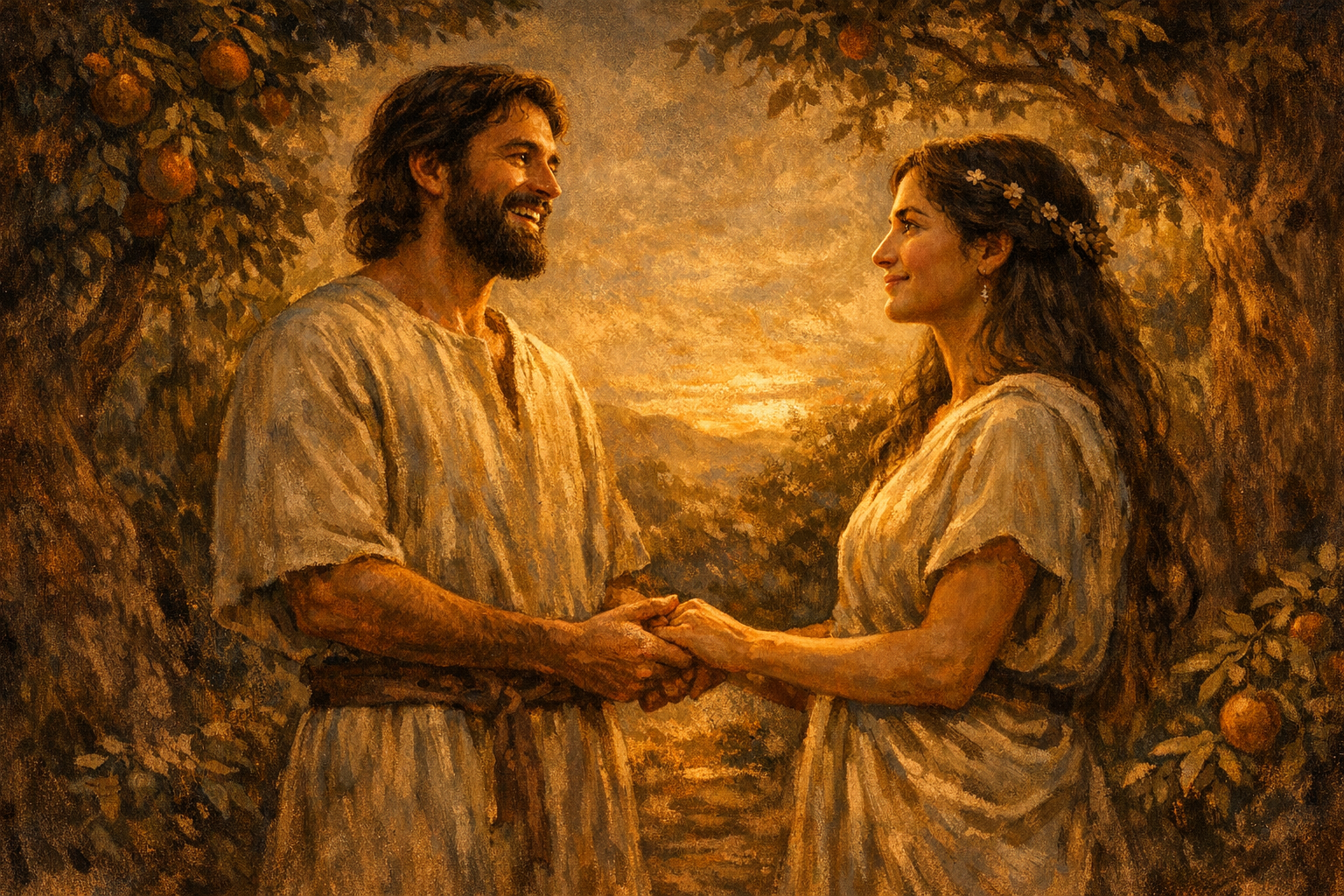
The story of marriage does not begin in a courthouse or a church building. It begins in a garden, with God Himself as the architect. In the very first chapters of Genesis, God surveys His creation and declares something remarkable — not about the world, but about a person being alone.
"And the LORD God said, It is not good that the man should be alone; I will make him an help meet for him." — Genesis 2:18 (KJV)
Notice that this declaration of "not good" comes before the Fall. Loneliness and the need for companionship are not consequences of sin — they are part of how God designed human beings. We are made for relationship. God then creates woman, and Adam's response is the first recorded poem in Scripture — a burst of joy and recognition.
"And Adam said, This is now bone of my bones, and flesh of my flesh: she shall be called Woman, because she was taken out of Man. Therefore shall a man leave his father and his mother, and shall cleave unto his wife: and they shall be one flesh." — Genesis 2:23-24 (KJV)
Three words define the biblical structure of marriage here: leave, cleave, and one flesh. Leaving means a new primary loyalty is formed. Cleaving means a permanent, covenant bond — not a trial arrangement. One flesh speaks to the total union of two lives: physical, emotional, spiritual, and social. This is the blueprint. And because it was established by God before sin, it carries a weight and dignity that no culture can improve upon or erase.
It is also significant that this covenant was established on the sixth day of a literal creation week — the same week in which God rested on the seventh-day Sabbath (Genesis 2:1-3). Marriage, like the Sabbath, is a creation ordinance — a gift given to all humanity, not just to Israel or to the church. Both point back to Eden; both remind us of who God is and who we are as His image-bearers.
2. The Image of God and Human Dignity
To understand why marriage matters, we must first understand what it means to be human. Genesis 1 gives us the foundation:
"So God created man in his own image, in the image of God created he him; male and female created he them." — Genesis 1:27 (KJV)
Every human being — male and female — bears the image of God. This is the bedrock of human dignity. It means that how we treat one another in our most intimate relationships is not merely a personal matter — it is a theological one. When a husband dishonors his wife, or a wife tears down her husband, something of the image of God is being treated carelessly. When parents neglect or abuse their children, they are mishandling image-bearers of the Most High.
The family, in God's design, is meant to be a little embassy of heaven — a place where the love, patience, grace, and faithfulness of God are modeled in human relationships. This is a high calling, and it is one that we cannot meet in our own strength.
3. Christ and the Church: The Pattern for Marriage
The New Testament does not abandon the creation design for marriage — it deepens it. The apostle Paul, writing to the church at Ephesus, draws a stunning parallel between marriage and the relationship between Christ and His church.
"Wives, submit yourselves unto your own husbands, as unto the Lord. For the husband is the head of the wife, even as Christ is the head of the church: and he is the saviour of the body." — Ephesians 5:22-23 (KJV)
"Husbands, love your wives, even as Christ also loved the church, and gave himself for it." — Ephesians 5:25 (KJV)
This passage is frequently misread. Paul is not giving husbands a license for domination. He is calling them to the most demanding standard imaginable — the self-sacrificing love of Christ, who gave His very life for those He loved. The headship Paul describes is servant-leadership modeled on the cross, not on worldly power. And the submission Paul calls wives to is not the submission of a slave to a master, but the willing, trusting response of the church to a Savior who has already proven His love at infinite cost.
This means that Christian marriage is meant to be a living sermon — a visible picture of the gospel. When a husband loves his wife with Christlike sacrifice, and a wife responds with trust and respect, the watching world sees something of the relationship between heaven and humanity. The Christian home becomes a witness.
4. Children: A Heritage from the Lord
The family that God designs is not only about the husband-wife relationship. Children are also part of the picture — and Scripture speaks of them with profound reverence.
"Lo, children are an heritage of the LORD: and the fruit of the womb is his reward." — Psalm 127:3 (KJV)
The word "heritage" here is significant. Children are not possessions; they are a trust from God. Parents are stewards, not owners. This shapes everything about how Christian parents approach child-rearing — with humility, prayer, and a deep sense of accountability to the One who gave these lives into their care.
The book of Proverbs gives parents a guiding principle that has shaped godly families across the centuries:
"Train up a child in the way he should go: and when he is old, he will not depart from it." — Proverbs 22:6 (KJV)
Training is not merely instruction — it is modeling. Children learn what love looks like by watching their parents love each other. They learn what faith looks like by watching their parents pray and trust God through difficulty. They learn what integrity looks like by watching their parents keep their word. The Christian home is the first and most powerful classroom.
And parents are given a corresponding responsibility to nurture without crushing:
"And, ye fathers, provoke not your children to wrath: but bring them up in the nurture and admonition of the Lord." — Ephesians 6:4 (KJV)
5. The Foundation That Cannot Be Shaken
Jesus closed His most famous sermon with a parable about two builders — one who built on sand, and one who built on rock. The difference was not in the storm that came; both houses faced the same wind and rain. The difference was in the foundation.
"Therefore whosoever heareth these sayings of mine, and doeth them, I will liken him unto a wise man, which built his house upon a rock: And the rain descended, and the floods came, and the winds blew, and beat upon that house; and it fell not: for it was founded upon a rock." — Matthew 7:24-25 (KJV)
Every family faces storms. Financial pressure, illness, conflict, grief, temptation — no household is immune. The question is not whether the storm will come, but what the family is built upon. A home built on the Word of God, on prayer, on the grace of Jesus Christ, and on covenant faithfulness — that home has a foundation that outlasts every storm.
This is why the Christian home must be saturated with Scripture, with worship, with honest conversation about faith. The Sabbath, observed weekly as God commanded, becomes a natural rhythm of rest and renewal for the family — a time to step back from the noise of the world and remember together who God is and what He has done. The seventh-day Sabbath (Saturday) is not merely a rule; it is a gift to families, a weekly invitation to reconnect with the Creator who designed the home in the first place.
6. Grace for Broken Families
We would be less than honest if we did not acknowledge that many young people reading this lesson do not come from the ideal family described above. Some come from homes marked by divorce, abuse, addiction, or abandonment. The Bible does not pretend these realities do not exist.
But hear this clearly: God's design for the family is not a standard meant to condemn those whose families have fallen short. It is a vision of what He is working to restore. The same God who established marriage in Eden is the God who heals the brokenhearted (Psalm 147:3). The same Christ who upheld the sanctity of marriage also showed extraordinary compassion to those whose relationships had failed (John 4:1-26).
Salvation is not reserved for people from perfect families. The grace of Jesus Christ reaches into every broken home and every wounded heart. And the church — the family of God — is called to be a community where those who have no earthly family can find belonging, love, and the experience of what a healthy, God-centered family feels like.
"God setteth the solitary in families: he bringeth out those which are bound with chains: but the rebellious dwell in a dry land." — Psalm 68:6 (KJV)
Reflection Questions
- Genesis 2:18-24 describes marriage as a creation ordinance established before sin. How does understanding marriage as God's design — rather than a human invention — change the way you think about relationships and commitment?
- Ephesians 5:25 calls husbands to love their wives "as Christ also loved the church, and gave himself for it." What does this kind of self-sacrificing love look like in everyday, practical terms? Why is this a higher standard than the world's view of love?
- Proverbs 22:6 says to "train up a child in the way he should go." Whether you are a young person, a future parent, or someone who influences younger children, what does this verse challenge you to model or demonstrate in your own life?
- Jesus said that the wise person builds on the rock of His words (Matthew 7:24-25). What are some practical ways a Christian home can be built on this foundation? What habits or rhythms help a family stay rooted in Christ?
- Psalm 68:6 says God "setteth the solitary in families." How can the church community serve as a spiritual family for those who come from broken or difficult home situations? What does this call you to do personally?
Practical Application
This week, take one concrete step to invest in a relationship within your family or your church family. If you live at home, consider initiating a conversation with a parent or sibling about something meaningful — perhaps sharing something you are learning in your faith. If you are older or living independently, reach out to someone in your church community who may be isolated or struggling. Commit to praying daily for your family — both biological and spiritual — asking God to make your home, whatever form it takes, a place where His love is visible and His presence is welcome. And as the Sabbath comes each week, receive it as a gift: a God-given pause to rest, reconnect, and remember that the One who designed the family is still at work, restoring what sin has broken.