
Made in God's Image, Broken by Sin
The Human Condition: Sin, Salvation, and the Cross • ~9 min read
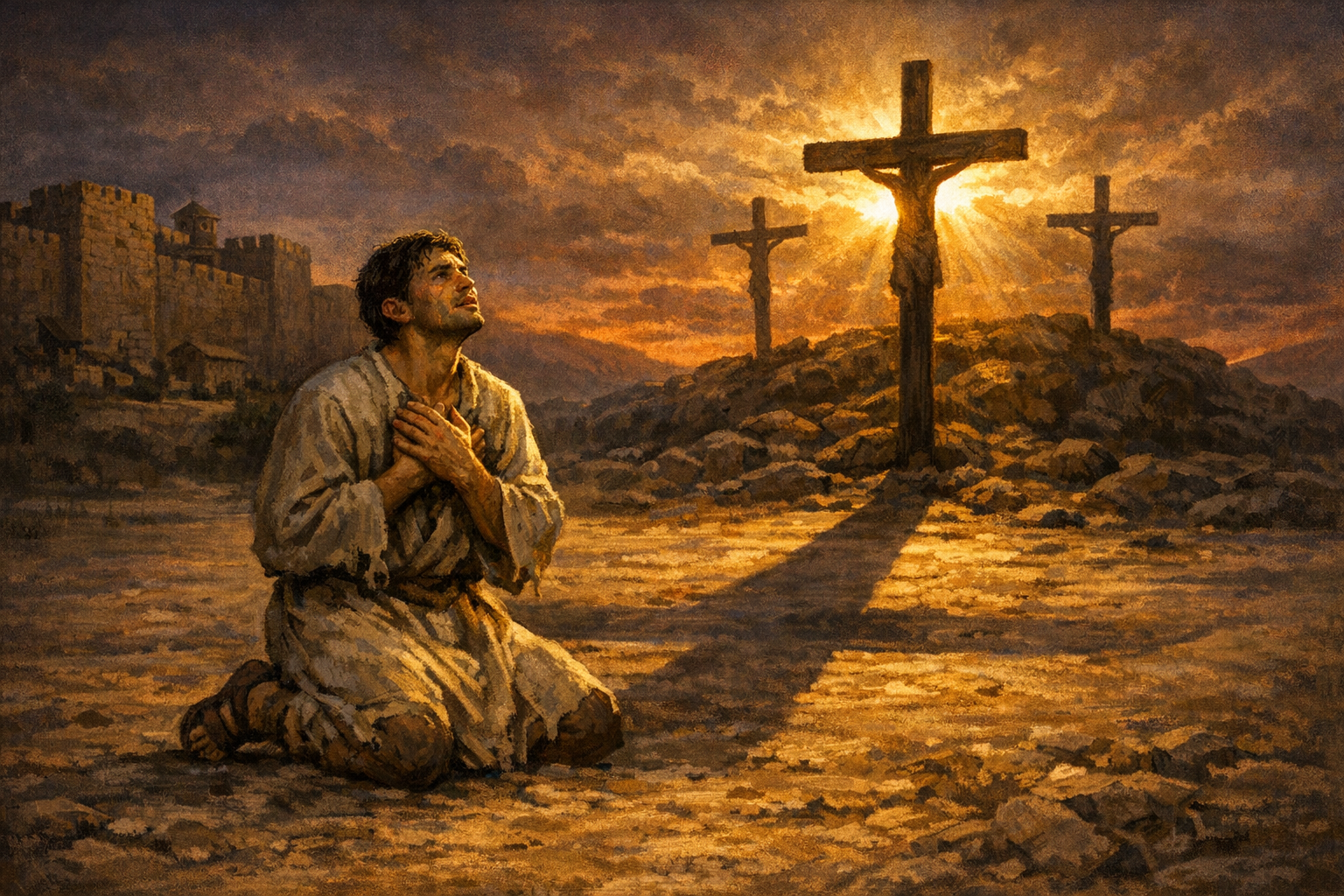
Made in God's Image, Broken by Sin
Foundations of Faith: 28 Core Adventist Doctrines for Youth — Lesson 4
Who are you, really? Not your username, not your GPA, not your reputation at school — but you, at the deepest level? That question has driven philosophers, scientists, and teenagers alike for centuries. The Bible cuts through every confused answer and gives us something breathtaking: you were made in the very image of God. But it also tells us the honest truth — something went terribly wrong. This lesson explores both realities, because you cannot understand grace until you understand what grace had to rescue.
Part 1: The Crown of Creation — Made in God's Image
The Creation of Humanity
The opening chapters of Genesis are not mythology or poetry about long evolutionary ages. They describe a literal, recent, six-day creation week in which God spoke the universe into existence and then, on the sixth day, did something uniquely personal: He made us.
"So God created man in his own image, in the image of God created he him; male and female created he them."
Genesis 1:27 (KJV)
"And the LORD God formed man of the dust of the ground, and breathed into his nostrils the breath of life; and man became a living soul."
Genesis 2:7 (KJV)
What Does "Image of God" Mean?
Notice two critical things in Genesis 2:7. First, God formed man from dust — we are physical, material beings. Second, God breathed into his nostrils the breath of life — the divine life-principle animated the physical body. The text says man became a living soul. The soul is not a separate immortal entity trapped inside a body (that idea comes from Greek philosophy, not the Bible). Rather, the "soul" is what you are — the whole living person — when body plus the breath of life are combined. This is foundational: human beings do not have a soul so much as they are a soul.
To be made in the image of God (the Hebrew word is tselem) means, among other things:
- Moral likeness: We were created righteous and holy, reflecting God's own character.
- Rational capacity: We can reason, plan, create, and communicate — capacities that mirror the mind of God.
- Relational design: Just as God exists in relationship (Father, Son, and Holy Spirit), we are designed for deep relationship — with God and with one another.
- Stewardship authority: God gave humanity dominion over the earth (Genesis 1:28), making us responsible caretakers of His creation.
- Spiritual responsiveness: We alone among creatures can worship, pray, and enter into covenant with our Creator.
This means every human being — regardless of race, ability, age, or status — carries the stamp of the divine. That is the foundation of human dignity.
Part 2: The Catastrophe — Broken by Sin
The Test of Trust
God placed our first parents in a perfect garden and gave them one prohibition — a single tree whose fruit they were not to eat. This was not cruelty; it was the condition for genuine love. Love that has no choice is not love at all. God wanted Adam and Eve to choose Him freely.
"But of the tree of the knowledge of good and evil, thou shalt not eat of it: for in the day that thou eatest thereof thou shalt surely die."
Genesis 2:17 (KJV)
The Deception and the Fall
A serpent — the vehicle of Satan's temptation — approached Eve and planted a seed of doubt about God's word and God's character.
"And the serpent said unto the woman, Ye shall not surely die: for God doth know that in the day ye eat thereof, then your eyes shall be opened, and ye shall be as gods, knowing good and evil."
Genesis 3:4-5 (KJV)
The lie was elegant in its simplicity: You will not die. God is holding out on you. You can be your own god. Eve believed the lie. Adam followed. And in that moment, everything changed.
"And when the woman saw that the tree was good for food, and that it was pleasant to the eyes, and a tree to be desired to make one wise, she took of the fruit thereof, and did eat, and gave also unto her husband with her; and he did eat."
Genesis 3:6 (KJV)
The Consequences of Sin
The fallout was immediate and devastating. Notice what God had said: "thou shalt surely die." The serpent said, "Ye shall not surely die." Who was right?
"In the sweat of thy face shalt thou eat bread, till thou return unto the ground; for out of it wast thou taken: for dust thou art, and unto dust shalt thou return."
Genesis 3:19 (KJV)
God was right. Death entered the world — not as an immediate dramatic collapse, but as a process of separation from the Source of life. The consequences of that first sin ripple through every generation:
- Spiritual death: Broken relationship with God — the hiding, the shame, the blame-shifting of Genesis 3:8-13.
- Physical death: The body, no longer sustained by unbroken access to the tree of life, began to decay.
- A corrupted nature: The image of God was not erased, but it was severely marred. Every human being born since carries the tendency toward sin.
- A broken world: Creation itself was subjected to futility — thorns, pain, and entropy entered the story.
Sin Is Universal
"Wherefore, as by one man sin entered into the world, and death by sin; and so death passed upon all men, for that all have sinned."
Romans 5:12 (KJV)
"For all have sinned, and come short of the glory of God."
Romans 3:23 (KJV)
This is not pessimism — it is diagnosis. A doctor who refuses to name a disease cannot treat it. The Bible names our condition clearly so that we can receive the cure clearly.
Part 3: What Happens When We Die?
Because the nature of humanity is so often misunderstood, it is important to address what death actually means according to Scripture. Remember: the "soul" is the whole living person — body plus the breath of life. What happens when that combination is undone?
"For the living know that they shall die: but the dead know not any thing, neither have they any more a reward; for the memory of them is forgotten."
Ecclesiastes 9:5 (KJV)
"His breath goeth forth, he returneth to his earth; in that very day his thoughts perish."
Psalm 146:4 (KJV)
Death is a sleep — an unconscious rest, with no awareness of time passing. This is not the end of the story; it is a pause before the resurrection. Jesus Himself described it this way when speaking of Lazarus:
"These things said he: and after that he saith unto them, Our friend Lazarus sleepeth; but I go, that I may awake him out of sleep."
John 11:11 (KJV)
The good news is that the sleep of death will be broken at the Second Coming. The righteous dead will be raised — gloriously, bodily, and completely — when Christ returns. Death is not the final word; the resurrection is.
"For the Lord himself shall descend from heaven with a shout, with the voice of the archangel, and with the trump of God: and the dead in Christ shall rise first: then we which are alive and remain shall be caught up together with them in the clouds, to meet the Lord in the air: and so shall we ever be with the Lord."
1 Thessalonians 4:16-17 (KJV)
Part 4: The Hope — Restored by Grace
The story does not end in Genesis 3. Even in the moment of judgment, God spoke a word of hope — what theologians call the protoevangelium, the first announcement of the gospel:
"And I will put enmity between thee and the woman, and between thy seed and her seed; it shall bruise thy head, and thou shalt bruise his heel."
Genesis 3:15 (KJV)
God promised that a Deliverer would come — one born of woman — who would crush the serpent's power, though at great personal cost. That Deliverer is Jesus Christ.
"For God so loved the world, that he gave his only begotten Son, that whosoever believeth in him should not perish, but have everlasting life."
John 3:16 (KJV)
"But God commendeth his love toward us, in that, while we were yet sinners, Christ died for us."
Romans 5:8 (KJV)
The same chapter that tells us sin entered through one man (Adam) tells us that grace overflows through one Man (Jesus Christ). We are not merely forgiven — we are being restored. The image of God, marred by sin, is being renewed in us through the sanctifying work of the Holy Spirit as we surrender daily to Christ.
"And be not conformed to this world: but be ye transformed by the renewing of your mind, that ye may prove what is that good, and acceptable, and perfect, will of God."
Romans 12:2 (KJV)
Salvation is not something we earn by good behavior. It is a gift received by faith — justification by grace through faith in Christ's atoning sacrifice. But true faith is never alone: it produces a changed life. Obedience is the fruit of salvation, not the root of it. We obey because we are loved and transformed, not in order to earn love.
Reflection Questions
- Identity check: Genesis 1:27 says you are made in the image of God. How does that truth challenge or change the way you think about yourself on a hard day? How does it change how you treat others?
- The nature of sin: The serpent's lie in Genesis 3:4-5 was essentially, "You don't need God — you can be your own god." Where do you see that same lie showing up in your world today? In your own heart?
- Death and hope: The Bible teaches that the dead are in an unconscious sleep until the resurrection. How does understanding death as a "sleep" rather than an immediate journey to heaven or hell change how you think about grief, funerals, or the promise of the Second Coming?
- Grace vs. earning: Romans 5:8 says Christ died for us "while we were yet sinners" — before we cleaned up, before we deserved it. Why is it important that salvation is by grace through faith and not by our own effort? What goes wrong when we try to earn God's love?
- Restoration in progress: Romans 12:2 calls us to be "transformed by the renewing of your mind." In what area of your life do you most need the Holy Spirit's transforming work right now? What would it look like to cooperate with that work this week?
Practical Application
This Week: See the Image, Name the Sin, Receive the Grace
Choose three practical steps to carry this lesson from your head into your daily life:
- See the image: Every day this week, when you interact with someone who frustrates or irritates you, pause and remind yourself: This person is made in the image of God. Let that truth shape how you speak and act toward them.
- Name the sin: Take five minutes in private prayer to honestly name one area where you have believed the serpent's lie — where you have tried to live as your own god, ignoring what God says. Confess it specifically. God already knows; naming it is for your own freedom.
- Receive the grace: Read Romans 5:1-11 slowly, once each morning this week. Let the reality of what Christ has done for you — while you were still a sinner — sink deeper each day. Let gratitude, not guilt, be the engine of your obedience.
You were made magnificent. You were broken by sin. You are being restored by grace. That is the arc of the whole Bible — and it is the story of your life in Christ.