
Christ Our High Priest and the Investigative Judgment
The Law, the Sabbath, and the Heavenly Sanctuary • ~12 min read
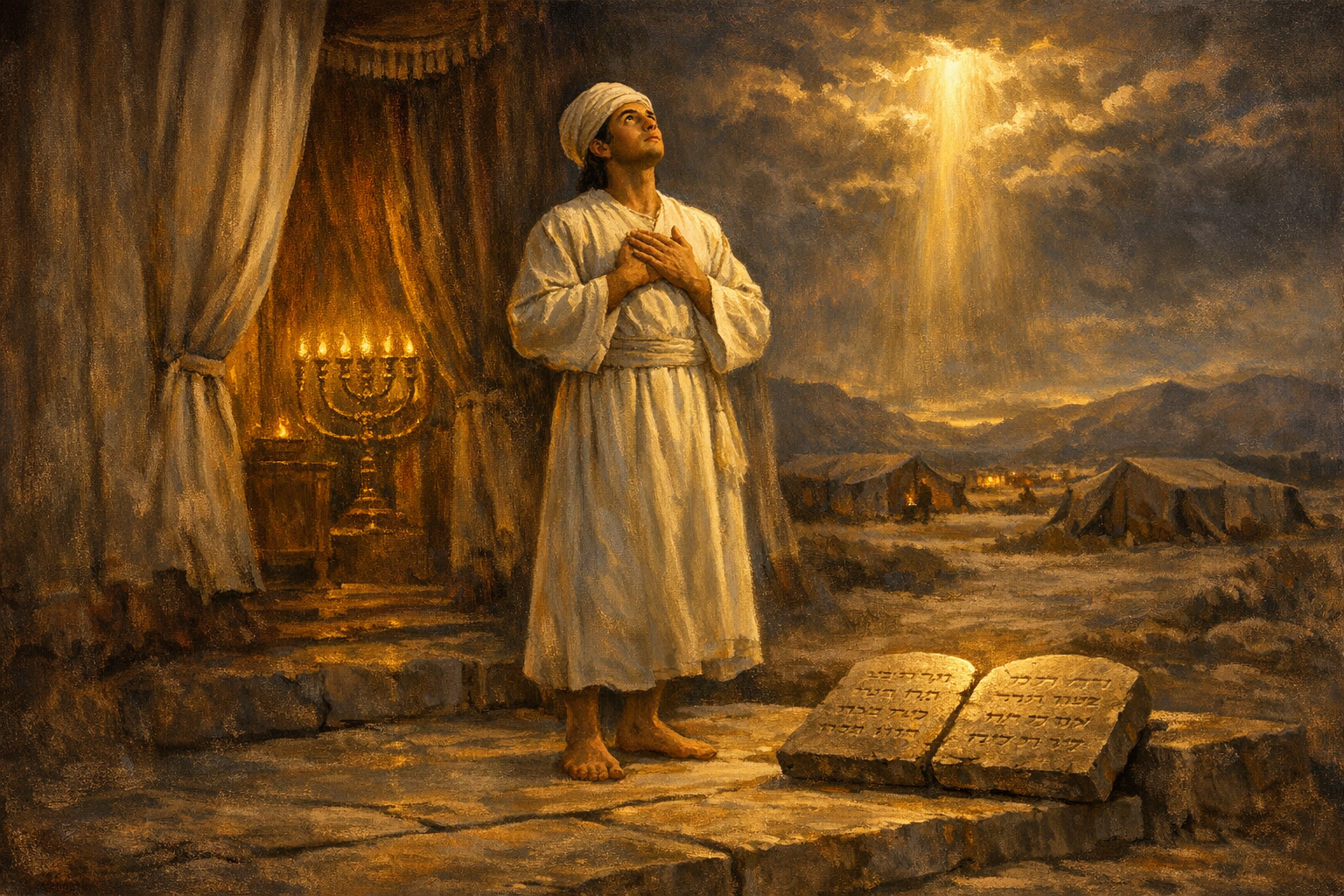
Christ Our High Priest and the Investigative Judgment
Foundations of Faith: 28 Core Adventist Doctrines for Youth — Lesson 18
Have you ever wondered what Jesus is doing right now? We know He died on the cross, rose from the dead, and ascended to heaven — but then what? Many people picture Jesus simply waiting until it is time to return to earth. The Bible, however, paints a far richer and more active picture. According to Scripture, Jesus is not idle in heaven. He is our living High Priest, interceding for us before the Father in the heavenly sanctuary, and He is engaged in a work of judgment that directly affects every person who has ever lived. This lesson explores that work — what it means, why it matters, and how it changes the way we live today.
1. The Heavenly Sanctuary: More Than a Symbol
The earthly tabernacle that Moses built was not an invention of human creativity. God gave Moses a precise pattern to follow, and that pattern pointed to something real in heaven.
"Who serve unto the example and shadow of heavenly things, as Moses was admonished of God when he was about to make the tabernacle: for, See, saith he, that thou make all things according to the pattern shewed to thee in the mount." — Hebrews 8:5 (KJV)
The writer of Hebrews is making a stunning claim: the earthly tabernacle was a shadow of a heavenly reality. Every sacrifice, every piece of furniture, every priestly ritual pointed forward and upward to something greater. Just as a shadow on the ground tells you that a real object is casting it, the earthly sanctuary tells us that a real heavenly sanctuary exists — one where the true ministry of redemption takes place.
"Now of the things which we have spoken this is the sum: We have such an high priest, who is set on the right hand of the throne of the Majesty in the heavens; A minister of the sanctuary, and of the true tabernacle, which the Lord pitched, and not man." — Hebrews 8:1-2 (KJV)
Notice the language: "the true tabernacle." The earthly one was a copy; the heavenly one is the original. And right now, at this very moment, Jesus Christ is serving as a minister in that true tabernacle.
2. Jesus: Our Great High Priest
Under the old covenant, the high priest was the only person who could enter the Most Holy Place — and only once a year, on the Day of Atonement, carrying the blood of the sacrifice. This annual ritual was a vivid picture of the need for atonement and the holiness of God. Jesus fulfills and surpasses this role completely.
"Seeing then that we have a great high priest, that is passed into the heavens, Jesus the Son of God, let us hold fast our profession. For we have not an high priest which cannot be touched with the feeling of our infirmities; but was in all points tempted like as we are, yet without sin." — Hebrews 4:14-15 (KJV)
This is one of the most comforting verses in the entire Bible. Jesus is not a distant, cold judge who has never experienced human struggle. He was hungry, tired, tempted, grieved, and misunderstood — yet He never sinned. That means when He intercedes for you, He does so with perfect empathy and perfect righteousness at the same time. He knows exactly what you are going through, and He has the power to help.
"Let us therefore come boldly unto the throne of grace, that we may obtain mercy, and find grace to help in time of need." — Hebrews 4:16 (KJV)
Because of Christ's ongoing priestly ministry, we do not approach God timidly or as strangers. We come boldly — not because we deserve it, but because our High Priest has opened the way through His own blood.
"But this man, because he continueth ever, hath an unchangeable priesthood. Wherefore he is able also to save them to the uttermost that come unto God by him, seeing he ever liveth to make intercession for them." — Hebrews 7:24-25 (KJV)
The phrase "save them to the uttermost" means Jesus saves completely, fully, and for all time those who come to God through Him. His intercession is not a one-time event — it is continuous. He "ever liveth" to stand before the Father on your behalf.
3. The Day of Atonement and Its Heavenly Fulfillment
To understand the investigative judgment, we must first understand the annual Day of Atonement (Yom Kippur) described in Leviticus 16. Throughout the year, Israelites brought their sin offerings to the tabernacle. The priest would symbolically transfer the sins of the people onto the sanctuary through these daily rituals. But the sanctuary itself needed to be cleansed — and that happened once a year on the Day of Atonement.
"And he shall make an atonement for the holy sanctuary, and he shall make an atonement for the tabernacle of the congregation, and for the altar, and he shall make an atonement for the priests, and for all the people of the congregation." — Leviticus 16:33 (KJV)
On that solemn day, the high priest entered the Most Holy Place with blood, making atonement for the entire congregation. It was a day of judgment — records were examined, so to speak, and those who had not humbled themselves were "cut off" from the people (Leviticus 23:29). The Day of Atonement was both a day of cleansing and a day of reckoning.
The prophet Daniel gives us the timeline for when this heavenly counterpart would begin:
"And he said unto me, Unto two thousand and three hundred days; then shall the sanctuary be cleansed." — Daniel 8:14 (KJV)
Using the prophetic day-year principle (where one prophetic day equals one literal year — see Numbers 14:34 and Ezekiel 4:6), 2,300 days equal 2,300 years. This period, beginning in 457 BC with the decree to restore and rebuild Jerusalem (Ezra 7), reaches to the year 1844. In that year, the great antitypical Day of Atonement began — the cleansing of the heavenly sanctuary, which involves a work of judgment before Christ's return.
4. The Investigative Judgment: What Daniel 7 Reveals
Daniel 7 provides the most detailed biblical picture of this pre-Advent judgment. In his vision, Daniel sees thrones set in place and the Ancient of Days taking His seat:
"I beheld till the thrones were cast down, and the Ancient of days did sit, whose garment was white as snow, and the hair of his head like the pure wool: his throne was like the fiery flame, and his wheels as burning fire. A fiery stream issued and came forth from before him: thousand thousands ministered unto him, and ten thousand times ten thousand stood before him: the judgment was set, and the books were opened." — Daniel 7:9-10 (KJV)
This is a scene of cosmic, heavenly judgment. Notice that the books are opened — records are being examined. This is not the final sentencing of the lost at the end of the millennium; this is a pre-Advent review of those who have professed to follow God. The outcome of this judgment determines who is counted worthy to receive eternal life at Christ's return.
"I saw in the night visions, and, behold, one like the Son of man came with the clouds of heaven, and came to the Ancient of days, and they brought him near before him. And there was given him dominion, and glory, and a kingdom, that all people, nations, and languages, should serve him: his dominion is an everlasting dominion, which shall not pass away, and his kingdom that which shall not be destroyed." — Daniel 7:13-14 (KJV)
After the judgment scene, the Son of Man receives His kingdom. This sequence is important: the judgment happens before Christ comes to reign. When Jesus returns, He already knows who belongs to Him. This is why Revelation 22:12 records Him saying that His reward is with Him when He comes — the decisions have already been made.
5. The Books of Record
The idea that God keeps records is not a frightening invention — it is a biblical truth woven throughout Scripture. The investigative judgment is grounded in the reality that God's justice is thorough and His knowledge is complete.
"And I saw the dead, small and great, stand before God; and the books were opened: and another book was opened, which is the book of life: and the dead were judged out of those things which were written in the books, according to their works." — Revelation 20:12 (KJV)
Two categories of books appear in Scripture's judgment scenes: books recording the deeds of humanity, and the Book of Life. The investigative judgment reviews the cases of those whose names are written in the Book of Life — those who have professed faith in Christ. The question being answered is: Has genuine repentance and faith taken hold? Is the character transformed by the Spirit? Has the blood of Christ truly been applied?
"He that overcometh, the same shall be clothed in white raiment; and I will not blot out his name out of the book of life, but I will confess his name before my Father, and before his angels." — Revelation 3:5 (KJV)
This verse reveals something sobering and encouraging at the same time. Names can be retained in the Book of Life — but the promise is given to those who overcome. Salvation is by grace through faith, but genuine faith produces a transformed life. The investigative judgment is not about earning salvation by works; it is about confirming whether the faith professed is real — whether Christ's righteousness has truly been received and reflected.
6. Christ Our Advocate: The Gospel in the Judgment
The investigative judgment is not meant to terrify the sincere believer. It is meant to demonstrate that God is just and that His salvation is real. At the center of this judgment stands Jesus Christ — not as our accuser, but as our Advocate.
"My little children, these things write I unto you, that ye sin not. And if any man sin, we have an advocate with the Father, Jesus Christ the righteous: And he is the propitiation for our sins: and not for ours only, but also for the sins of the whole world." — 1 John 2:1-2 (KJV)
The word "advocate" is a legal term — it means a defense attorney, someone who pleads your case. When your name comes up in the judgment, Jesus Christ stands before the Father and presents His own blood as the ground of your justification. He is both the Advocate and the Propitiation — the one who pleads your case and the sacrifice that makes your acquittal possible.
"For there is one God, and one mediator between God and men, the man Christ Jesus; Who gave himself a ransom for all, to be testified in due time." — 1 Timothy 2:5-6 (KJV)
There is no other mediator. No saint, no priest, no church institution can stand between you and God. Jesus alone is the Mediator — and He gave Himself as a ransom. The cross is the foundation of everything that happens in the heavenly sanctuary. The investigative judgment does not add to the cross; it applies the cross to every individual life.
7. Living in the Hour of His Judgment
The angel of Revelation 14 proclaims an urgent message to the entire world:
"And I saw another angel fly in the midst of heaven, having the everlasting gospel to preach unto them that dwell on the earth, and to every nation, and kindred, and tongue, and people, Saying with a loud voice, Fear God, and give glory to him; for the hour of his judgment is come: and worship him that made heaven, and earth, and the sea, and the fountains of waters." — Revelation 14:6-7 (KJV)
Notice: the everlasting gospel and the announcement of judgment go together. This is not a message of fear for the believer — it is a call to reverence, worship, and urgent response. We are living in the very hour described here. Since 1844, the investigative judgment has been in progress. This gives every generation alive today a profound reason to take the gospel seriously, to surrender fully to Christ, and to allow His Spirit to transform every area of life.
The call to "worship him that made heaven, and earth" is also a direct call back to the fourth commandment — the Sabbath, the memorial of creation. In the context of end-time judgment, true worship of the Creator is inseparably linked to honoring the seventh-day Sabbath that He blessed and sanctified (Genesis 2:2-3; Exodus 20:8-11). The investigative judgment and the Sabbath truth belong together in God's end-time message.
8. Assurance in the Judgment
Does the investigative judgment rob us of assurance? Absolutely not — if our assurance is rightly grounded. The believer's confidence is not in personal worthiness but in Christ's perfect righteousness credited to us.
"For by grace are ye saved through faith; and that not of yourselves: it is the gift of God: Not of works, lest any man should boast." — Ephesians 2:8-9 (KJV)
"There is therefore now no condemnation to them which are in Christ Jesus, who walk not after the flesh, but after the Spirit." — Romans 8:1 (KJV)
The phrase "in Christ Jesus" is the key. Those who are truly united with Christ by faith — not merely in name, but in genuine surrender and ongoing relationship — have no condemnation. The investigative judgment does not threaten those who are walking with Jesus; it vindicates them. It demonstrates before the entire universe that God's grace is real, that His people are genuinely transformed, and that His salvation is just.
At the same time, the New Testament is clear that genuine faith is not passive. Sanctification — the ongoing work of the Holy Spirit transforming the believer's character — is the evidence that justification is real. Obedience is not the root of our salvation; it is the fruit. But where there is no fruit at all, we must ask whether there is any root.
"But wilt thou know, O vain man, that faith without works is dead?" — James 2:20 (KJV)
Reflection Questions
- Hebrews 4:15-16 tells us that Jesus was "in all points tempted like as we are, yet without sin." How does knowing that your High Priest has personally experienced human weakness change the way you approach Him in prayer?
- The earthly Day of Atonement was a solemn day of self-examination for Israel. In what practical ways should the reality of the ongoing heavenly Day of Atonement — the investigative judgment — shape how you live each day?
- Revelation 3:5 promises that Christ will not blot out the name of the one who overcomes. What does it mean to "overcome" according to Scripture (see also 1 John 5:4-5), and how is overcoming connected to faith rather than self-effort?
- 1 John 2:1-2 calls Jesus our "Advocate" and our "propitiation." In your own words, explain how these two roles of Christ — defense attorney and atoning sacrifice — work together to give the believer confidence in the judgment.
- Revelation 14:6-7 links the everlasting gospel with the announcement that "the hour of his judgment is come" and a call to worship the Creator. How does this connection challenge you personally in your understanding of worship, the Sabbath, and the urgency of sharing the gospel?
Practical Application
This week, set aside time each day for what the Bible calls "coming boldly to the throne of grace" (Hebrews 4:16). Before you pray, spend a few moments in honest self-examination — not to earn favor, but to open your heart fully to your High Priest. Confess any known sin, claim the advocacy of Jesus Christ, and ask the Holy Spirit to make His transforming work real in a specific area of your life. Keep a simple journal of what you bring to the throne of grace and how God responds over the week. Let the reality of Christ's active ministry in the heavenly sanctuary move your faith from a set of beliefs you hold in your head to a living relationship you walk in every day.