
Meeting Needs, Building Bridges: Compassion as Discipleship
Why Your Life Preaches: The Character That Makes Disciples • ~11 min read
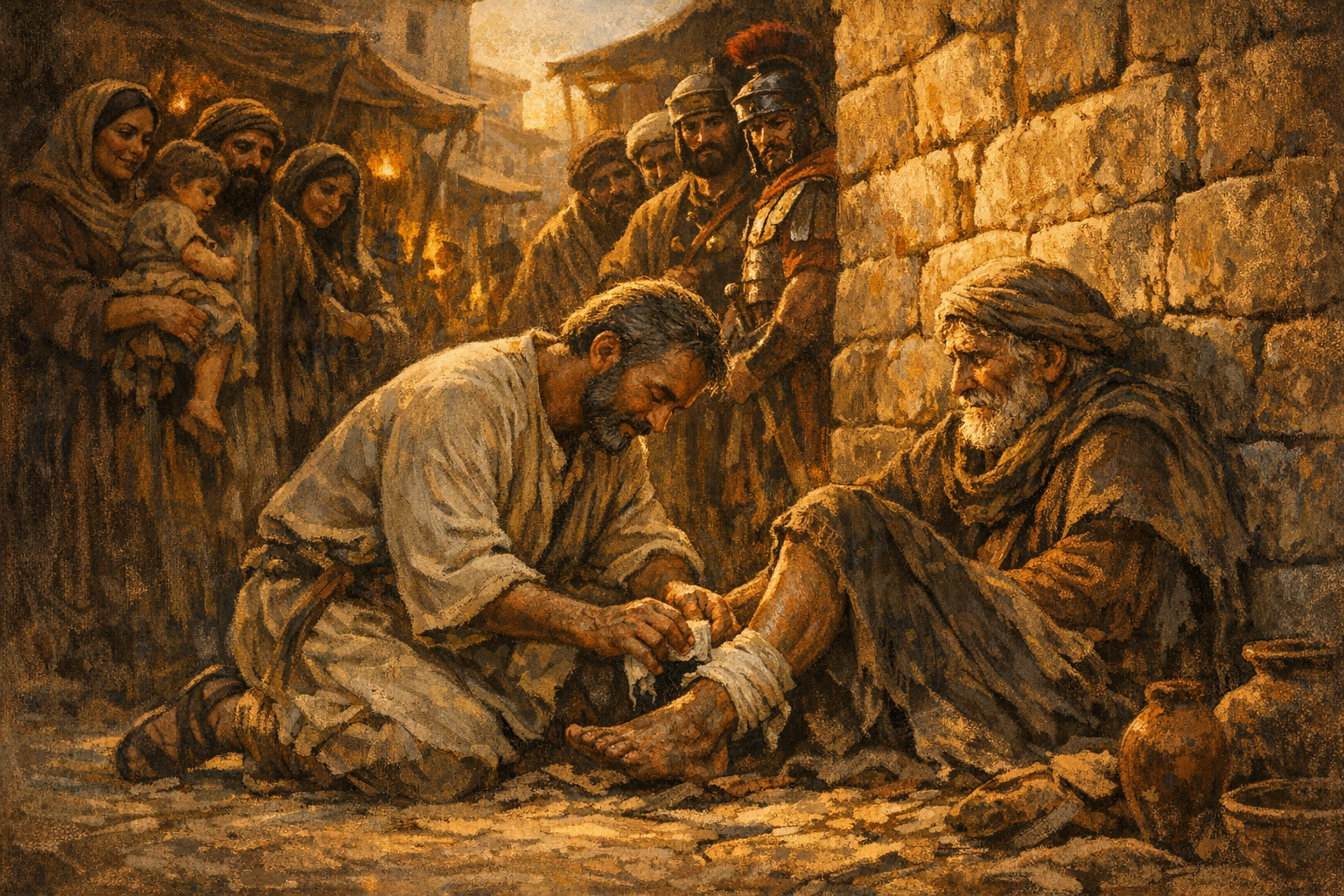
Meeting Needs, Building Bridges: Ministry of Compassion
Part of the Series: Awakening Spiritual Interest: Reaching Every Heart for God
There is a language that every human heart understands, regardless of culture, background, or belief — the language of compassion. Before many people will ever open a Bible or sit in a pew, they first need to know that someone genuinely cares about them. The ministry of compassion is not a preliminary step before "real" evangelism begins; it is evangelism — the embodied proclamation that God sees, God cares, and God acts. In this lesson we will explore how meeting practical human needs builds the bridges over which the gospel travels, and how Jesus modeled this holistic approach as the pattern for His church in every generation.
1. The Pattern of Jesus: Word and Deed Together
The Gospels present Jesus as one who never separated proclamation from compassion. He preached the kingdom and simultaneously healed the sick, fed the hungry, and touched the untouchable. Matthew's summary of His early ministry is striking in its comprehensiveness:
"And Jesus went about all Galilee, teaching in their synagogues, and preaching the gospel of the kingdom, and healing all manner of sickness and all manner of disease among the people. And his fame went throughout all Syria: and they brought unto him all sick people that were taken with divers diseases and torments, and those which were possessed with devils, and those which were lunatick, and those that had the palsy; and he healed them."
— Matthew 4:23-24 (KJV)
Notice the threefold rhythm: teaching, preaching, healing. Jesus did not offer words without works, nor works without words. The healing of the body opened ears to hear the healing of the soul. This is the divine pattern — compassionate ministry creates the relational and spiritual soil in which the seed of the gospel can take root.
Later, when John the Baptist sent messengers to ask whether Jesus was truly the Messiah, Jesus did not offer a theological argument. He pointed to His compassionate works as the evidence:
"Jesus answered and said unto them, Go and shew John again those things which ye do hear and see: The blind receive their sight, and the lame walk, the lepers are cleansed, and the deaf hear, the dead are raised up, and the poor have the gospel preached to them."
— Matthew 11:4-5 (KJV)
The ministry of compassion was not incidental to Jesus' mission — it was central proof of it. When we follow His pattern, we become living evidence of the gospel we proclaim.
2. The Great Commission Includes the Whole Person
Some have mistakenly concluded that the church's mandate is purely spiritual — saving souls while leaving bodies and social conditions untouched. But Jesus' commission to His disciples was far broader. He sent them out with both authority and compassion:
"And he called his twelve disciples together, and gave them power and authority over all devils, and to cure diseases. And he sent them to preach the kingdom of God, and to heal the sick."
— Luke 9:1-2 (KJV)
The disciples were not given a choice between preaching and healing. Both were part of the same commission. The same pattern is seen when Jesus sent out the seventy:
"And heal the sick that are therein, and say unto them, The kingdom of God is come nigh unto you."
— Luke 10:9 (KJV)
The healing preceded the proclamation, but both were inseparable. The act of compassion was itself a declaration: the kingdom of God has drawn near to you. Every time we meet a genuine human need in Christ's name, we are making that same declaration.
3. The Theology of the Neighbor: Who Needs a Bridge?
When a lawyer asked Jesus to define the limits of neighborly obligation, Jesus responded not with a definition but with a story — the parable of the Good Samaritan (Luke 10:30-37). The Samaritan, considered an outsider by the religious establishment, crossed every social and ethnic boundary to bind up the wounds of a stranger. Jesus' conclusion was revolutionary:
"Which now of these three, thinkest thou, was neighbour unto him that fell among the thieves? And he said, He that shewed mercy on him. Then said Jesus unto him, Go, and do thou likewise."
— Luke 10:36-37 (KJV)
The neighbor is not defined by geography, ethnicity, or religious affiliation — the neighbor is defined by need and our willingness to respond. The bridge of compassion reaches across every human divide. This is precisely why ministry of compassion is so powerful in awakening spiritual interest: it dismantles the walls of suspicion and prejudice that often prevent people from hearing the gospel at all.
4. Faith That Works: The Epistle of James
The apostle James confronts any temptation to reduce Christianity to intellectual assent while ignoring practical need. His words are uncomfortably direct:
"If a brother or sister be naked, and destitute of daily food, And one of you say unto them, Depart in peace, be ye warmed and filled; notwithstanding ye give them not those things which are needful to the body; what doth it profit? Even so faith, if it hath not works, is dead, being alone."
— James 2:15-17 (KJV)
James is not teaching that works earn salvation — the entire New Testament is clear that we are justified by faith in Christ's atoning sacrifice, not by our own merit. Rather, James is teaching that genuine saving faith inevitably expresses itself in loving action. Obedience and compassionate service are the fruit of salvation, not its root. A faith that never moves the hands and feet to help a suffering neighbor is not the living faith that saves; it is a hollow profession.
When believers meet real needs — food, clothing, shelter, companionship, healing — they are not earning favor with God. They are demonstrating that God's grace has already transformed them, and in doing so, they make that grace visible and credible to those who have not yet encountered it.
5. The Judgment of the Nations: Compassion as a Kingdom Marker
In Matthew 25, Jesus paints a breathtaking picture of the final judgment. The standard by which the nations are assessed is startling in its simplicity — it is not doctrinal precision but compassionate action:
"For I was an hungred, and ye gave me meat: I was thirsty, and ye gave me drink: I was a stranger, and ye took me in: Naked, and ye clothed me: I was sick, and ye visited me: I was in prison, and ye came unto me."
— Matthew 25:35-36 (KJV)
"And the King shall answer and say unto them, Verily I say unto you, Inasmuch as ye have done it unto one of the least of these my brethren, ye have done it unto me."
— Matthew 25:40 (KJV)
This passage does not contradict the gospel of grace; it reveals the character that grace produces. Those who have truly been transformed by the love of Christ cannot encounter suffering without responding. Every hungry person, every stranger, every prisoner — in them, Christ Himself presents an opportunity to demonstrate the kingdom. This is the ultimate motivation for compassionate ministry: we are not merely helping people, we are, in a profound and mysterious sense, serving Christ Himself.
It is also worth noting the eschatological dimension of this passage. Jesus is describing the final judgment — a theme deeply connected to the Seventh-day Adventist understanding of Christ's ongoing high-priestly ministry in the heavenly sanctuary and the pre-Advent investigative judgment. The character formed through a life of compassionate service is the character that stands in that judgment — not because compassion earns salvation, but because it is the evidence that salvation has truly been received and lived out.
6. Isaiah's Vision: True Religion in Action
Long before the New Testament, the prophet Isaiah articulated God's vision for the kind of service that pleases Him. In Isaiah 58, God rebukes empty religious ritual and calls His people to something far more demanding and far more beautiful:
"Is not this the fast that I have chosen? to loose the bands of wickedness, to undo the heavy burdens, and to let the oppressed go free, and that ye break every yoke? Is it not to deal thy bread to the hungry, and that thou bring the poor that are cast out to thy house? when thou seest the naked, that thou cover him; and that thou hide not thyself from thine own flesh?"
— Isaiah 58:6-7 (KJV)
And what is the promised result of this kind of compassionate living?
"Then shall thy light break forth as the morning, and thine health shall spring forth speedily: and thy righteousness shall go before thee; the glory of the LORD shall be thy rereward."
— Isaiah 58:8 (KJV)
The ministry of compassion is not a drain on the church's spiritual vitality — it is a source of it. When God's people engage the broken world with practical love, their own light intensifies. Bridges built to others become avenues of blessing in both directions.
7. Paul and the Collection: The Unity of Gospel and Generosity
The apostle Paul devoted significant energy to organizing a relief offering among the Gentile churches for the suffering believers in Jerusalem. For Paul, this was not merely a charitable project — it was a theological statement about the unity of the body of Christ and the credibility of the gospel:
"For it hath pleased them of Macedonia and Achaia to make a certain contribution for the poor saints which are at Jerusalem. It hath pleased them verily; and their debtors they are. For if the Gentiles have been made partakers of their spiritual things, their duty is also to minister unto them in carnal things."
— Romans 15:26-27 (KJV)
Paul saw material generosity as the natural overflow of spiritual blessing. Those who have received the riches of the gospel are moved to share material resources with those in need. This principle applies directly to outreach: when the church meets the physical and social needs of its community, it demonstrates that the gospel it preaches is not merely theoretical but transforming.
8. Building Bridges: Practical Principles for Compassionate Ministry
a. Start Where People Are
Effective compassionate ministry begins with listening. Before offering solutions, we must understand the actual needs of those we seek to serve. Jesus consistently met people at their point of felt need — a blind man wanted sight, a paralyzed man wanted to walk, a hungry crowd wanted food. He never dismissed these needs as unspiritual.
b. Serve Without Strings
Compassion loses its power when it becomes manipulation. The goal is not to coerce people into religious attendance by dangling material assistance. We serve because Christ served us, freely and unconditionally. The gospel will speak for itself when it is embodied in genuine, no-strings-attached love.
c. Involve the Whole Church
The New Testament model is not a professional clergy doing ministry while the congregation watches. Paul describes the church as a body in which every member has a function:
"Now ye are the body of Christ, and members in particular."
— 1 Corinthians 12:27 (KJV)
Every believer has gifts, time, and resources that can be deployed in compassionate service. When the whole congregation engages in meeting community needs, the witness is multiplied far beyond what any single program can achieve.
d. Let Compassion Open the Door to the Gospel
Peter instructs believers to be ready to give an account of the hope within them when people ask:
"But sanctify the Lord God in your hearts: and be ready always to give an answer to every man that asketh you a reason of the hope that is in you with meekness and fear."
— 1 Peter 3:15 (KJV)
Compassionate ministry creates the questions. When people see Christians serving sacrificially and joyfully, they naturally ask why. That question is the open door to sharing the gospel. The bridge of compassion leads to the city of grace.
Reflection Questions
- Jesus combined teaching, preaching, and healing in His ministry (Matthew 4:23-24). In what ways does your local church reflect this threefold balance? Where might there be room to grow in the ministry of compassion?
- James warns that faith without works is dead (James 2:15-17). How do you personally distinguish between trusting in compassionate works for salvation versus expressing genuine faith through loving action? How do you guard against both extremes — dead faith and works-based religion?
- Jesus identified Himself with "the least of these" in Matthew 25:40. How does this truth change the way you view the people in your community who are suffering, marginalized, or overlooked? Does this perspective motivate or challenge you?
- The Good Samaritan crossed social and religious boundaries to help a stranger (Luke 10:36-37). What boundaries — cultural, economic, social, or personal — might you need to cross in order to build bridges of compassion in your community?
- Isaiah 58:8 promises that when God's people engage in genuine compassionate service, their own "light shall break forth as the morning." Have you experienced spiritual renewal or growth as a result of serving others? What does this suggest about the relationship between outward ministry and inward spiritual vitality?
Practical Application
This week, identify one specific, concrete need in your immediate community — a neighbor who is lonely, a family facing food insecurity, a colleague going through a health crisis, or a local organization serving the vulnerable that needs volunteers. Commit to taking one practical step to meet that need, doing so in the name of Christ and without any expectation of return. As you serve, pray for an opportunity to share, simply and naturally, why you care — and be ready, as Peter says, to give an answer for the hope that is in you. Keep a brief journal note of what you did, how the person responded, and what you sensed God doing through the encounter. Bring that reflection to your next group gathering and share what you learned about the connection between compassion and the awakening of spiritual interest.