
Keeping the Flame Alive: Nurture and Discipleship
Why Follow-Through Matters: From Decision to Discipleship • ~13 min read
Keeping the Flame Alive: Nurture and Discipleship
Introduction
Every flame, however brightly it ignites, requires fuel, oxygen, and careful tending if it is to endure. The same is true of spiritual life. When the gospel awakens a heart — when conviction falls, when faith stirs, when a soul turns toward God — that moment of awakening is not the end of the journey but its very beginning. The great commission does not merely call us to win converts; it calls us to make disciples. Discipleship is the sacred work of keeping the flame alive: walking alongside new believers, feeding them with the Word, modeling a life of grace, and drawing them ever deeper into the community of faith. This lesson explores what the Scriptures teach about nurturing spiritual growth and the solemn, joyful responsibility every believer carries toward those who are young in the faith.
The Great Commission: More Than a Moment
Jesus did not say, "Go and make converts." His command was far richer and far more demanding than that. In the closing verses of Matthew's Gospel, He laid out the full scope of the mission:
"Go ye therefore, and teach all nations, baptizing them in the name of the Father, and of the Son, and of the Holy Ghost: Teaching them to observe all things whatsoever I have commanded you: and, lo, I am with you alway, even unto the end of the world. Amen." — Matthew 28:19-20 (KJV)
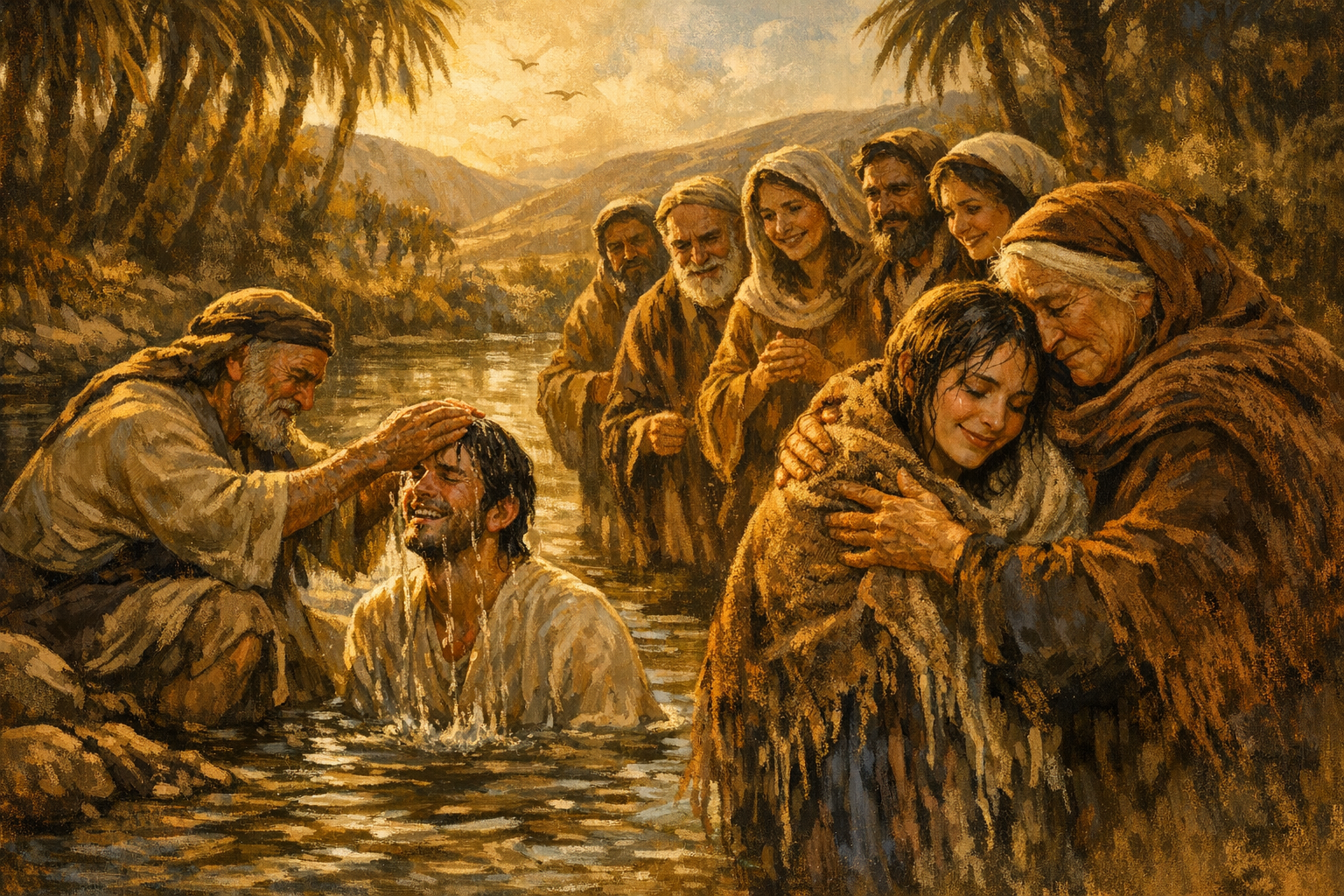
Notice the structure of the commission. Baptism — the public, immersive act of dying to self and rising in Christ — is followed immediately by a second, ongoing task: teaching them to observe all things. Baptism by full immersion, following genuine repentance and faith, marks the new birth and entry into the covenant community. But the teaching that follows is not a single class or a brief orientation. It is a lifelong apprenticeship in the way of Jesus. The flame of new faith must be fed by continuous instruction in "all things" Christ commanded. Discipleship, then, is not optional post-baptism programming; it is the very substance of the commission.
The Pattern of the Early Church
When the Spirit fell at Pentecost and three thousand souls were added to the church in a single day, the apostles did not simply celebrate the harvest and move on. Luke records the deliberate, structured nurture that followed:
"And they continued stedfastly in the apostles' doctrine and fellowship, and in breaking of bread, and in prayers." — Acts 2:42 (KJV)
Four pillars held up the life of the newly awakened community: apostolic doctrine (the Word faithfully taught), fellowship (koinonia — shared life and mutual accountability), the breaking of bread (worship and remembrance of the Lord's sacrifice), and prayer (dependence upon God). These were not occasional events but the steady, daily rhythm of a community committed to keeping every flame burning. Notice that the text says they "continued stedfastly" — the Greek word conveys perseverance, even stubbornness. Nurture requires that kind of tenacity. It is easy to gather a crowd; it is costly to stay with people through their struggles, doubts, and slow growth.
The Shepherd's Heart: Feeding the Flock
The imagery of the shepherd runs throughout Scripture as God's own picture of pastoral care. After the resurrection, Jesus pressed this responsibility upon Peter with unmistakable repetition:
"He saith unto him again the second time, Simon, son of Jonas, lovest thou me? He saith unto him, Yea, Lord; thou knowest that I love thee. He saith unto him, Feed my sheep." — John 21:16 (KJV)
To love Christ is to feed His sheep. The verb "feed" carries the idea of shepherding in its fullest sense — providing pasture, guiding to water, protecting from predators, seeking the lost, and binding up the wounded. New believers are, by definition, lambs: vulnerable, inexperienced, and easily led astray. The church that evangelizes without shepherding has, in a very real sense, left lambs in the wilderness. Every member of the body of Christ shares in this shepherding responsibility, not pastors alone.
The Apostle Peter later extended this charge to all the elders of the church:
"Feed the flock of God which is among you, taking the oversight thereof, not by constraint, but willingly; not for filthy lucre, but of a ready mind; Neither as being lords over God's heritage, but being ensamples to the flock." — 1 Peter 5:2-3 (KJV)
The shepherd leads by example — being an ensample to the flock. Discipleship is caught as much as it is taught. New believers watch how mature Christians handle suffering, temptation, disappointment, and the daily disciplines of prayer and Scripture. Our lives are either an invitation deeper into Christ or a stumbling block placed in the path of the young.
Paul's Model: The Nursing Mother and the Gentle Father
No one in the New Testament articulates the emotional and relational texture of discipleship more vividly than the Apostle Paul. Writing to the Thessalonians — a church he had planted and then been forced to leave prematurely — he describes his pastoral heart in tender, domestic language:
"But we were gentle among you, even as a nurse cherisheth her children: So being affectionately desirous of you, we were willing to have imparted unto you, not the gospel of God only, but also our own souls, because ye were dear unto us." — 1 Thessalonians 2:7-8 (KJV)
Paul did not merely transfer information to the Thessalonians; he imparted his own soul. True discipleship is not a curriculum — it is a relationship. It costs the discipler something deeply personal: time, emotional energy, vulnerability, and love. A few verses later, Paul shifts the metaphor:
"As ye know how we exhorted and comforted and charged every one of you, as a father doth his children, That ye would walk worthy of God, who hath called you unto his kingdom and glory." — 1 Thessalonians 2:11-12 (KJV)
The father exhorts (calls forward), comforts (stands alongside in pain), and charges (urges with holy seriousness). These three actions together describe a balanced discipleship that neither coddles nor crushes, but consistently calls the disciple upward toward a life worthy of the God who called them. The goal is always the same: that they would "walk worthy of God."
The Word as Spiritual Nourishment
Just as a newborn infant requires milk before solid food, new believers require a steady, appropriately sequenced diet of Scripture. Peter makes this biological analogy explicit:
"As newborn babes, desire the sincere milk of the word, that ye may grow thereby: If so be ye have tasted that the Lord is gracious." — 1 Peter 2:2-3 (KJV)
The phrase "sincere milk" translates a Greek word meaning pure, unadulterated — free from deceit or mixture. The Word of God, taught honestly and in context, is the primary nourishment of the growing soul. Discipleship programs that substitute entertainment, sentimentality, or watered-down theology for rigorous engagement with Scripture ultimately starve the very people they intend to feed. The flame needs real fuel.
Paul reinforces this in his charge to Timothy:
"All scripture is given by inspiration of God, and is profitable for doctrine, for reproof, for correction, for instruction in righteousness: That the man of God may be perfect, throughly furnished unto all good works." — 2 Timothy 3:16-17 (KJV)
Scripture is profitable in four directions: it teaches what is true (doctrine), confronts what is wrong (reproof), restores what has gone astray (correction), and trains in what is right (instruction in righteousness). A discipleship relationship that uses all four of these scriptural functions will produce believers who are "throughly furnished" — completely equipped — for every good work God calls them to.
The Law, the Sabbath, and the Shape of Discipleship
Genuine discipleship forms the whole person according to the whole counsel of God, including the moral law. Jesus was explicit that His coming did not dissolve the commandments:
"Think not that I am come to destroy the law, or the prophets: I am not come to destroy, but to fulfil. For verily I say unto you, Till heaven and earth pass, one jot or one tittle shall in no wise pass from the law, till all be fulfilled." — Matthew 5:17-18 (KJV)
The Decalogue — the Ten Commandments — remains the perpetual moral standard for the believer, not as a ladder to earn salvation, but as the description of a life transformed by grace. Obedience is the fruit of salvation, never its root. We are justified by faith in Christ's atoning sacrifice alone; we are then sanctified by the Spirit's ongoing, transforming work as we walk in covenant faithfulness.
Among the commandments, the fourth — the Sabbath — holds special significance for discipleship. The seventh-day Sabbath (Saturday), instituted at creation and written in stone at Sinai, is God's perpetual sign of the Creator-Redeemer relationship:
"Remember the sabbath day, to keep it holy. Six days shalt thou labour, and do all thy work: But the seventh day is the sabbath of the LORD thy God: in it thou shalt not do any work, thou, nor thy son, nor thy daughter, thy manservant, nor thy maidservant, nor thy cattle, nor thy stranger that is within thy gates: For in six days the LORD made heaven and earth, the sea, and all that in them is, and rested the seventh day: wherefore the LORD blessed the sabbath day, and hallowed it." — Exodus 20:8-11 (KJV)
Weekly Sabbath observance is itself a discipleship rhythm. Every seventh day, the disciple stops, rests, and remembers: God is Creator; I am creature. God is Redeemer; I am redeemed. The Sabbath teaches new believers that their worth is not in their productivity but in their relationship with the God who made them and bought them back. Nurturing new believers into Sabbath-keeping is nurturing them into a weekly encounter with the character of God.
Christ's Intercession and the Heavenly Sanctuary
Discipleship does not depend on human effort alone. Every believer who nurtures another does so under the high-priestly ministry of Jesus Christ, who is even now interceding in the heavenly sanctuary on behalf of His people:
"Wherefore he is able also to save them to the uttermost that come unto God by him, seeing he ever liveth to make intercession for them." — Hebrews 7:25 (KJV)
The phrase "to the uttermost" is gloriously comprehensive — Christ's saving, sustaining work reaches to the farthest extent of human need and human failure. The disciple who stumbles, who doubts, who falls and rises again, is held not merely by the faithfulness of a human mentor but by the eternal intercession of a risen, ascended, ministering High Priest. This truth should fill every discipleship relationship with hope: we do not keep the flame alive by our own ingenuity. Christ Himself tends the fire.
"Seeing then that we have a great high priest, that is passed into the heavens, Jesus the Son of God, let us hold fast our profession. For we have not an high priest which cannot be touched with the feeling of our infirmities; but was in all points tempted like as we are, yet without sin. Let us therefore come boldly unto the throne of grace, that we may obtain mercy, and find grace to help in time of need." — Hebrews 4:14-16 (KJV)
Part of discipleship is teaching new believers to come boldly to this throne — to pray, to confess, to receive mercy, and to find grace in their moments of greatest need. A disciple who knows how to access the throne of grace has been given a resource that will sustain them long after their human mentor is no longer present.
The Body of Christ: Mutual Edification
Discipleship is never a solo enterprise. God has designed the church as a body in which every member contributes to the growth of every other member:
"But speaking the truth in love, may grow up into him in all things, which is the head, even Christ: From whom the whole body fitly joined together and compacted by that which every joint supplieth, according to the effectual working in the measure of every part, maketh increase of the body unto the edifying of itself in love." — Ephesians 4:15-16 (KJV)
Growth happens when truth and love are held together. Truth without love becomes harsh and brittle; love without truth becomes sentimental and directionless. Every joint in the body — every member, regardless of age or spiritual maturity — supplies something the rest of the body needs. New believers, fresh from the world, often bring a passion and perspective that rekindles the fire in long-established members. Discipleship flows in both directions.
Paul also calls the community to active, intentional mutual care:
"Let us therefore follow after the things which make for peace, and things wherewith one may edify another." — Romans 14:19 (KJV)
"Brethren, if a man be overtaken in a fault, ye which are spiritual, restore such an one in the spirit of meekness; considering thyself, lest thou also be tempted. Bear ye one another's burdens, and so fulfil the law of Christ." — Galatians 6:1-2 (KJV)
Restoration — not condemnation — is the posture of the mature disciple toward the one who has stumbled. The spirit of meekness is essential; the restorer must approach with the awareness that they, too, are capable of falling. This humility is what makes the discipleship relationship safe enough for honest confession and genuine growth.
The Hope That Sustains Discipleship: The Second Coming
All nurture and discipleship is oriented toward a glorious horizon. We do not disciple people merely to make them better citizens or more ethical individuals. We disciple them toward the day when Jesus Christ returns — literally, visibly, audibly, personally — to gather His people:
"For the Lord himself shall descend from heaven with a shout, with the voice of the archangel, and with the trump of God: and the dead in Christ shall rise first: Then we which are alive and remain shall be caught up together with them in the clouds, to meet the Lord in the air: and so shall we ever be with the Lord." — 1 Thessalonians 4:16-17 (KJV)
This hope is not escapism — it is the anchor of discipleship. When the work is slow, when a disciple wanders, when discouragement sets in, the promise of Christ's return rekindles the discipler's resolve. Every soul nurtured in faith is a soul being prepared to meet Jesus face to face. Paul used this very hope to motivate the Thessalonians' discipleship relationships:
"For what is our hope, or joy, or crown of rejoicing? Are not even ye in the presence of our Lord Jesus Christ at his coming? For ye are our glory and joy." — 1 Thessalonians 2:19-20 (KJV)
The people we disciple are our "crown of rejoicing" at the coming of the Lord. There is no greater motivation for keeping the flame alive in another person's heart than the vision of standing together before Christ on that day.
Reflection Questions
- Matthew 28:19-20 (KJV) commands us to teach new believers "to observe all things" Christ commanded. In your own discipleship relationships — formal or informal — which of Christ's teachings do you find most difficult to pass on faithfully, and why?
- Paul describes his discipleship of the Thessalonians in terms of both a nursing mother (gentleness and self-giving) and a caring father (exhortation, comfort, and charge). Which of these dimensions comes most naturally to you, and which requires more intentional growth?
- Acts 2:42 (KJV) identifies four pillars of early church nurture: apostolic doctrine, fellowship, breaking of bread, and prayer. Which of these four is most lacking in your local church's approach to caring for new believers, and what practical steps could address that gap?
- Hebrews 4:14-16 (KJV) invites believers to come boldly to the throne of grace. How consistently do you teach new believers to bring their struggles directly to Christ in prayer, rather than depending primarily on human support? What would change if you made this more central?
- Paul calls the people he discipled his "hope, joy, and crown of rejoicing" at Christ's coming (1 Thessalonians 2:19-20, KJV). How does the reality of the Second Coming shape the urgency and tenderness with which you invest in the spiritual growth of others?
Practical Application
This week, identify one person in your congregation or circle of influence who is newer in faith — someone recently baptized, recently recommitted, or still exploring. Make a specific, calendar-marked commitment to meet with them at least once in the next seven days. Come prepared with one Scripture passage to study together (perhaps beginning with 1 Peter 2:1-3), one question that invites them to share how their walk with God is going, and one prayer offered specifically for their growth. Do not wait for a formal program to authorize this. The commission of Matthew 28 is already your authority. Ask God each morning this week to give you a shepherd's heart — eyes that see the lambs, hands that are willing to carry them, and a voice that speaks truth in love. Keep the flame alive in someone else, and watch what God does in your own heart in the process.