
The Grand Sweep of History: Daniel 2 & 7 • ~10 min read
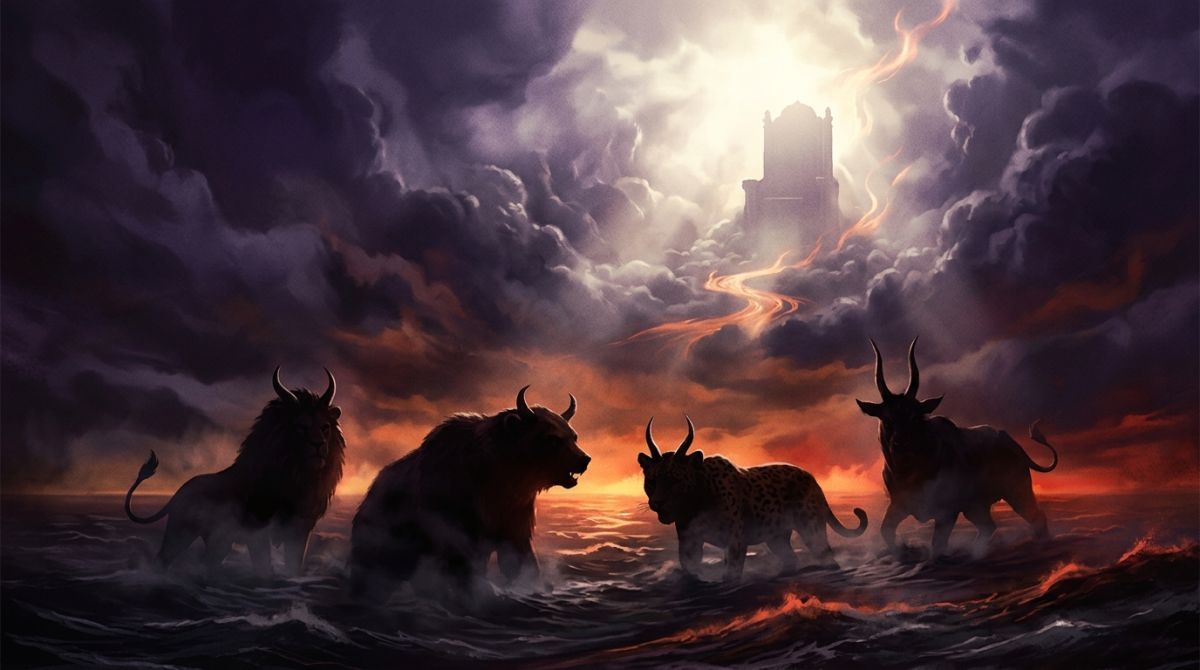
Welcome back to our study as we continue to unveil God's timeless plan for humanity! Last time, we explored the broad strokes of history through Daniel chapter 2. Today, we're diving deeper into Daniel chapter 7, where God reveals the same sequence of world powers, but with even more profound detail and a crucial introduction to heaven's ultimate judgment. This vision is rich with symbolism, showing us not only the rise and fall of earthly kingdoms but also the challenging power that would emerge, and how God, the Ancient of Days, presides over all history, ensuring justice and the triumph of His eternal kingdom.
Daniel chapter 7 opens with a vivid, somewhat unsettling vision that Daniel himself received. It's a powerful parallel to the great image of Daniel 2, but instead of metals, God uses symbolic beasts to represent the major empires that would dominate the world stage.
In the first year of Belshazzar king of Babylon Daniel had a dream and visions of his head upon his bed: then he wrote the dream, and told the sum of the matters.
Daniel 7:1-3
Daniel spake and said, I saw in my vision by night, and, behold, the four winds of the heaven strove upon the great sea.
And four great beasts came up from the sea, diverse one from another.
The "great sea" often symbolizes peoples, multitudes, nations, and languages in prophecy (Revelation 17:15), and the "four winds" represent strife and war, from which kingdoms arise. Let's look at the first three beasts:
The first was like a lion, and had eagle's wings: I beheld till the wings thereof were plucked, and it was lifted up from the earth, and made stand upon the feet as a man, and a man's heart was given to it.
Daniel 7:4-6
And behold another beast, a second, like to a bear, and it raised up itself on one side, and it had three ribs in the mouth of it between the teeth of it: and they said thus unto it, Arise, devour much flesh.
After this I beheld, and lo another, like a leopard, which had upon the back of it four wings of a fowl; the beast had also four heads; and dominion was given to it.
These beasts represent the same first three kingdoms as the gold head, silver chest, and bronze thighs of Daniel 2:
Then, Daniel sees a fourth, uniquely terrifying beast:
After this I saw in the night visions, and behold a fourth beast, dreadful and terrible, and strong exceedingly; and it had great iron teeth: it devoured and brake in pieces, and stamped the residue with the feet of it: and it was diverse from all the beasts that were before it; and it had ten horns.
Daniel 7:7-8
I considered the horns, and, behold, there came up among them another little horn, before whom there were three of the first horns plucked up by the roots: and, behold, in this horn were eyes like the eyes of man, and a mouth speaking great things.
This fourth beast, "dreadful and terrible," clearly represents the Roman Empire, mirroring the iron legs of Daniel 2. Its "great iron teeth" symbolize its crushing power. The "ten horns" represent the division of the Roman Empire into ten kingdoms, which would later become the nations of Europe. Most strikingly, "another little horn" emerges among these ten, a power that would rise to prominence and speak "great things." This little horn is a key focus of this prophecy, and we'll explore its characteristics more fully.
Just as the little horn power begins to emerge and assert itself, Daniel's vision shifts dramatically from earthly turmoil to a scene of solemn judgment in heaven. This is a pivotal moment, revealing God's active involvement and ultimate authority over all earthly affairs.
I beheld till the thrones were cast down, and the Ancient of days did sit, whose garment was white as snow, and the hair of his head like the pure wool: his throne was like the fiery flame, and his wheels as burning fire.
Daniel 7:9-10
A fiery stream issued and came forth from before him: thousand thousands ministered unto him, and ten thousand times ten thousand stood before him: the judgment was set, and the books were opened.
This is a breathtaking scene! The "Ancient of days" is God the Father, portrayed here in majesty, purity, and supreme authority. The "thrones were cast down" or "placed" (as some translations render it) to set the stage for this divine court. "Thousand thousands ministered unto him, and ten thousand times ten thousand stood before him" describes the immense multitude of heavenly beings present. The "judgment was set, and the books were opened," indicating that a solemn legal process is taking place in heaven. This heavenly judgment occurs before the second coming of Christ, emphasizing that God meticulously reviews the records and vindicates His people before the final events of earth's history.
Daniel, troubled by the vision, seeks understanding, and an angel provides a clear interpretation, especially regarding the fourth beast and the little horn.
Thus he said, The fourth beast shall be the fourth kingdom upon earth, which shall be diverse from all kingdoms, and shall devour the whole earth, and shall tread it down, and break it in pieces.
Daniel 7:23-24
And the ten horns out of this kingdom are ten kings that shall arise: and another shall rise after them; and he shall be diverse from the first, and he shall subdue three kings.
The angel confirms what we've already understood: the fourth beast is a fourth kingdom, Rome, and the ten horns are ten kings or kingdoms that would emerge from it. The "little horn" would rise "after them" and subdue three of these initial kingdoms, establishing its power.
The angel then describes the unique and challenging characteristics of this "little horn" power:
And he shall speak great words against the most High, and shall wear out the saints of the most High, and think to change times and laws: and they shall be given into his hand until a time and times and the dividing of time.
Daniel 7:25
This "little horn" power has three distinct characteristics:
But the vision doesn't end with the triumph of this oppressive power. It culminates in God's ultimate victory and the establishment of His eternal kingdom:
But the judgment shall sit, and they shall take away his dominion, to consume and to destroy it unto the end.
Daniel 7:26-27
And the kingdom and dominion, and the greatness of the kingdom under the whole heaven, shall be given to the people of the saints of the most High, whose kingdom is an everlasting kingdom, and all dominions shall serve and obey him.
Here is the glorious conclusion! The heavenly judgment we saw earlier ensures that the dominion of the "little horn" is taken away. Ultimately, God's kingdom, described as "an everlasting kingdom," will be established, and all dominion will be given to "the people of the saints of the most High." This promise assures us that despite the rise of formidable earthly powers and even a persecuting entity, God's plan will prevail, and His faithful people will inherit an eternal kingdom that will never be destroyed.
Daniel 7 provides a profound journey through history, from the rise and fall of powerful symbolic beasts representing earthly empires, to the emergence of a challenging, persecuting power, and finally to the majestic scene of God's heavenly judgment. This judgment ensures the end of all earthly oppression and the glorious establishment of God's everlasting kingdom, where His saints will reign with Him. It's a powerful reminder that while earthly powers rise and fall, God remains sovereign, and His eternal plan for His people will ultimately triumph.