
The Vision of Daniel 8: The Ram, Goat, and Little Horn • ~10 min read
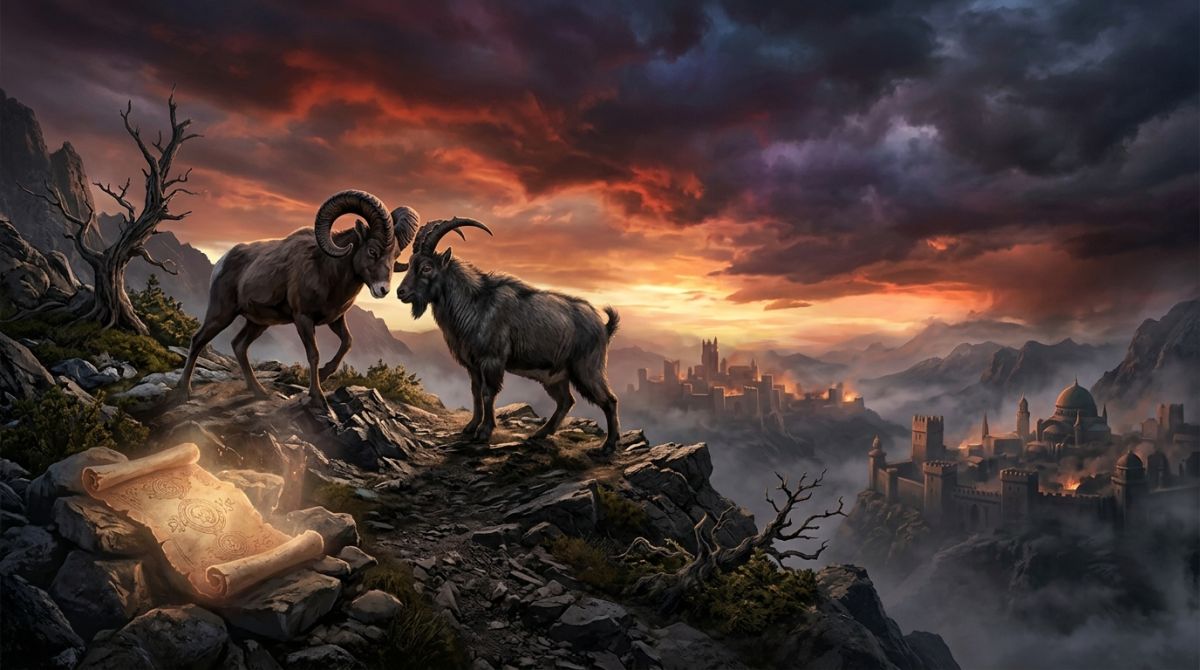
Dear friends, as we continue our journey through the book of Daniel, we are invited to witness God's incredible foreknowledge of human history. In Daniel chapter 8, the prophet receives another profound vision, one that unveils the rise and fall of mighty empires that would shape the world for centuries to come. This vision not only confirms the truths we've already learned but also introduces new details about specific powers and their interactions. It assures us that God is in control, orchestrating events according to His divine plan, even amidst the turmoil and conflicts of nations. Let's open our Bibles and explore this fascinating prophecy.
Daniel's vision begins with a striking image of a powerful animal, a ram, symbolizing a great empire that would dominate the ancient world. Let's read his description:
Daniel 8:3-4 (KJV): "Then I lifted up mine eyes, and saw, and, behold, there stood before the river a ram which had two horns: and the two horns were high; but one was higher than the other, and the higher came up last. I saw the ram pushing westward, and northward, and southward; so that no beasts might stand before him, neither was there any that could deliver out of his hand; but he did according to his will, and became great."
Here, Daniel sees a ram with two horns, one growing higher than the other, indicating two distinct but related powers. This ram was incredibly strong, pushing its conquests in three directions—westward, northward, and southward—without anyone being able to resist its might. What empire is this? The angel Gabriel provides the clear interpretation later in the chapter, leaving no room for speculation:
Daniel 8:20 (KJV): "The ram which thou sawest having two horns are the kings of Media and Persia."
This confirms that the ram represents the Medo-Persian Empire, which succeeded Babylon as the dominant world power, just as we saw in Daniel chapter 7 with the bear. The "two horns" signify the Medes and the Persians, with the Persians (the "higher came up last") eventually becoming the more dominant of the two. Historical records confirm their vast conquests in the directions mentioned, establishing a massive empire from India to Ethiopia. God's prophetic word gives us a clear picture of future events long before they unfold.
Just as the ram seemed invincible, a new, incredibly swift power emerges from the west, challenging the established order. Daniel describes this dramatic encounter:
Daniel 8:5-7 (KJV): "And as I was considering, behold, an he goat came from the west on the face of the whole earth, and touched not the ground: and the goat had a notable horn between his eyes. And he came to the ram that had two horns, which I had seen standing before the river, and ran unto him in the fury of his power. And I saw him come close unto the ram, and he was moved with choler against him, and smote the ram, and brake his two horns: and there was no power in the ram to stand before him, but he cast him down to the ground, and stamped upon him: and there was none that could deliver the ram out of his hand."
Imagine the speed and ferocity! This "he goat" moves so rapidly it "touched not the ground," symbolizing an incredibly swift conquest. It possesses a "notable horn" between its eyes, indicating a powerful and prominent leader. This goat attacks the ram with overwhelming force, breaking its two horns and utterly defeating it. Again, the Bible provides the divine commentary:
Daniel 8:21 (KJV): "And the rough goat is the king of Grecia: and the great horn that is between his eyes is the first king."
This identifies the "he goat" as the Grecian Empire and the "great horn" as its first king—Alexander the Great. History vividly recounts Alexander's meteoric rise and his astonishingly rapid conquests, sweeping across Asia Minor, the Middle East, and into India, decisively overthrowing the mighty Persian Empire. His campaigns were so swift that it truly seemed as if his armies "touched not the ground." This remarkable fulfillment testifies to the accuracy of God's Word.
But the vision doesn't end with the goat's victory. What happens to this "great horn," this powerful first king?
Daniel 8:8 (KJV): "Therefore the he goat waxed very great: and when he was strong, the great horn was broken; and for it came up four notable ones toward the four winds of heaven."
Here we see a sudden turn of events: just as the goat reached its peak of power, its "great horn was broken." This represents the untimely death of Alexander the Great at the height of his conquests. Following his death, his vast empire did not remain united. Instead, four "notable ones" came up "toward the four winds of heaven," signifying a division into four distinct kingdoms.
Once more, the divine interpretation confirms this understanding:
Daniel 8:22 (KJV): "Now that being broken, whereas four stood up for it, four kingdoms shall stand up out of the nation, but not in his power."
This prophecy was fulfilled precisely. After Alexander's death in 323 B.C., his generals, after years of conflict, eventually divided his empire into four main Hellenistic kingdoms: Cassander ruled Macedon and Greece, Lysimachus ruled Thrace and parts of Asia Minor, Seleucus ruled Syria and the vast eastern territories, and Ptolemy ruled Egypt and Palestine. These four kingdoms, though powerful, never collectively wielded the same singular authority or extent of territory that Alexander himself commanded. This detailed foresight underscores God's absolute sovereignty.
The vision of Daniel 8, with its vivid imagery of the ram and the he goat, provides a stunning preview of future world history, specifically the rise and fall of the Medo-Persian and Grecian empires. God's prophetic word, given centuries before these events unfolded, proves His omnipotence and His intimate knowledge of all that transpires on earth. He reveals the future not to satisfy idle curiosity, but to strengthen our faith, assuring us that He is indeed the sovereign Ruler of the universe. As we see these prophecies fulfilled with such precision, our confidence in the reliability of God's Word can only deepen, reminding us that His promises for our future are just as sure. As Isaiah 46:9-10 reminds us, "Remember the former things of old: for I am God, and there is none else; I am God, and there is none like me, Declaring the end from the beginning, and from ancient times the things that are not yet done, saying, My counsel shall stand, and I will do all my pleasure."